
Reflections on the Role of NLU's Educational Leaders in the Future of Education
Remarks of the Dean of the National College of Education, Robert D. Muller, at NLU's 2022 Doctoral Hooding Ceremony

Robert D. Muller
Dean, National College of Education
Doctoral Hooding Ceremony Remarks
June 22, 2022
National Louis University has a sizeable impact on the future of American education through its preparation of outstanding education leaders. This year’s doctoral degree recipients joined a large and prominent community of NCE alumni in Chicagoland and beyond.
In 2022, our graduates received their Ed.D. in:
- PK-12 Educational Leadership, preparing for leadership roles in PK-12 schools and districts in including the superintendency;
- Higher Education Leadership, preparing for leadership in postsecondary and adjacent institutions; and
- Teaching and Learning, with concentrations in Curriculum, Advocacy and Policy; Reading and Literacy; and Disability and Equity in Education.
Highly Relevant Research
Let me reflect for a moment on the outstanding and provocative dissertation work of our doctoral candidates.
I have often said to my colleagues that if we took all the dissertation research of NCE recent graduates and organized it by topic and interest, we would have a solid plan for addressing some of the most important challenges facing American education today.
The research reflected in this year’s graduates’ dissertations bridges research, policy and practice. In fact, it is this principle of focusing on applied questions facing real classrooms, real schools, real learners and real educators today, and approaching those questions through a lens of data and research that brings power to the collective work of our graduates. Our doctoral candidates have examined the capacity of school districts, family and community engagement, the impact of online learning, leadership transitions, culturally responsive pedagogy, social emotional learning, assessment practices, and many other topics. If there is a unifying theme, it is fundamentally about equity, and how do we create the systems, conditions and processes where all learners achieve their potential.
Our students have many reasons for deciding to pursue a doctoral degree at NLU. Career advancement perhaps, content knowledge, skills acquisition, leadership development, being part of a learning community. With many motivations, now we celebrate each individual’s accomplishments – here at the finish line, done. What resilience to have accomplished this in our incredibly tumultuous times.
I encourage our graduates to reflect on where their dissertation work will take them. How can they move beyond the micro-analysis of each particular study to advancing and advocating for more systemic changes?
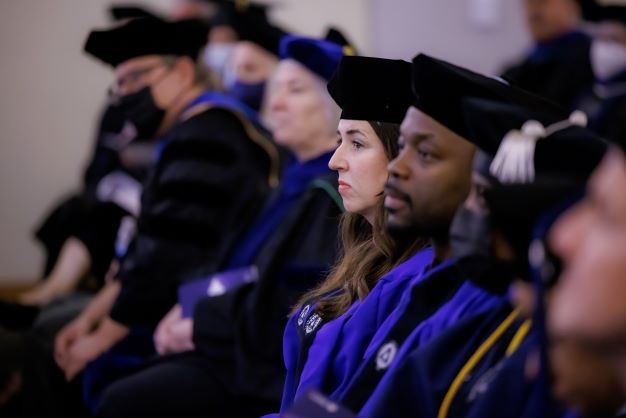
The Leadership Challenge Calling New Graduates
I offered six suggestions to our doctoral degree recipients.
First -- crisis leads to opportunity, and as leaders of tomorrow, they have the ability to guide us and the institutions they serve to a better tomorrow. Find the opportunity amidst what appear to be intractable problems.
Second -- challenge common assumptions -- actually challenge all assumptions, including one’s own, not just those of folks with whom one disagrees.
Third -- do not accept the status quo. Push in new, different directions. It’s time not to think just outside the box, but rather to think around the corner. Question conventional wisdom. Ask a lot of questions.
Fourth -- don’t neglect work-life balance. It may be cliché, but leadership really is a marathon and not a sprint. The demands on our education leaders can be overwhelming, and we need to support them to succeed.
Fifth - seek out differences, and aim to understand them. We’re in a fragile time characterized by political name-calling, labelling and judgment. Today’s politics stoke emotional extremes and feed oppositional thinking, but there is no reason an educational leader has to follow that path.
A corollary to number five. Find common ground, seek shared interests. For example, I noticed a recent article that reported that many individuals object to the term Social Emotional Learning (SEL), but simultaneously are likely to be supportive of what it entails. Or consider the seemingly never-ending reading wars. There is no simple answer captured in a sound bite – as with most important endeavors, teaching reading is incredibly complex. Skip the finger pointing and positionality and embrace the complexity, challenge and joy of helping every child learn.
Avoid labels, which are often misunderstood and misused anyway, and unpack the values and contents therein instead. As humans we like to categorize things, but we often overdo it, and as educators, we know that both/and is far more powerful than either/or. Educators can find common ground. Our responsibility is for seeing, for listening, and for championing informed and thoughtful change.
Sixth and finally, I am hopeful. Why? Because when I looked around the room at the combined power and impact of our graduates, I see lots of reason for hope. I look forward to hearing and reading about their leadership successes and impact in the months and years ahead. At our doctoral ceremony, we celebrated an impressive cadre of passionate educators with the capacity, skills, commitment and wherewithal – in fact the obligation – to work to make big changes to improve society and reach our vision of educational opportunity without barriers for all. They join the larger network of NLU alumni making real differences in education every day.

