
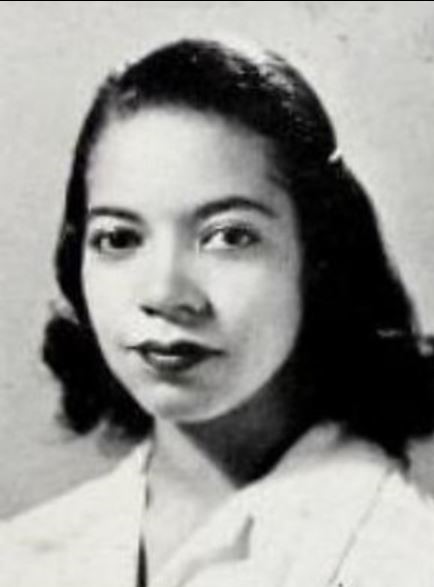
Pictured above: Mary Elizabeth Moore, the first black graduate of NLU's National College of Education.
For over 80 years, Black scholars and leaders have shaped the legacy of National Louis University, breaking barriers and creating lasting change. From the first Black graduate in 1949 to today's leadership, each milestone represents a step forward in the university's commitment to diversity and excellence.
In 1949, Mary Elizabeth Moore made history as the first Black student to graduate from the National College of Education (NCE). An Evanston native who began her journey in 1946, Moore specialized in education and music after receiving a scholarship. Her campus involvement was extensive, including roles in the Drama club, Choir, International Club, and serving as sophomore class treasurer. Moore's impact extended far beyond graduation. She became the inaugural Assistant Regional Director of Education for the National Urban League in Los Angeles, later serving as Executive Director for the Fair Housing Council in California and Director of Education for Planned Parenthood.
The 1950s marked continued progress, beginning with Winifred Thomas becoming the first Black graduate student in 1953. Thelma Adams broke barriers as class Treasurer in 1955, paving the way for Sylvia Peters (née Samples), who became Class Officer in 1957 and the first Black May Queen in 1958. Peters' influence in education reached national levels. She became an award-winning principal, served as Dean of Student Teachers at the University of Southern California and Rio Grande Valley for "Teach for America," and appeared in films, television programs, and high-profile speaking platforms.
The 1960s saw significant growth in Black student representation and leadership. Gloria Dorsey and Barbara Reeves joined the College Council in 1965, fostering inclusive dialogue across campus. Dorsey's academic excellence earned her recognition in Who's Who Among Students in American Universities and Colleges in 1966. In 1968, Barbara Reeves was crowned May Queen. A watershed moment came in 1969 with the creation of UMOJA, NCE's first Black student union, marking a new era of organized Black student community and advocacy.
The 1970s brought cultural and academic expansion. Pulitzer Prize winner Gwendolyn Brooks visited NCE in 1970, while UMOJA evolved into UBSANCE (United Black Student Alliance of National College of Education) in 1971, serving as an intellectual bridge between students and faculty. The university introduced African American History courses in 1973, and in 1974, the establishment of Alpha Kappa Alpha (AKA) sorority connected NCE to the prestigious "Divine Nine" Black Greek organizations.
In recent years, there has been unprecedented Black leadership at NLU. In 2021, Dr. Kelli Johnson was named Dean of the College of Psychology and Behavioral Sciences. In 2022, Dr. Eddie Phillips became the first African-American Provost and Vice President for Academic Affairs, the same year Dr. Carolyn Theard-Griggs was appointed Dean of NCE and Dr. Anita Moore-Bohannon became the first Black Vice President of Student Affairs. In 2023, Dr. Jamal Scott was appointed Vice President of Undergraduate Studies and Dean of the Undergraduate College. Student initiatives continue to flourish, with the creation of a Black Student group in 2021 and the launch of the Black Scholars Educational Excellence Narrative (BSEEN) program in 2023, fostering community and celebrating Black diaspora experiences.
This rich history of Black excellence at National Louis University continues to grow, building on the foundation laid by pioneers like Mary Elizabeth Moore and inspiring future generations of leaders and scholars.
