Mentoring Novice Teacher Candidates: How NLU’s National College of Education Teacher Preparation Team Supports Mentor Teachers
NLU’s National College of Education (NCE) firmly believes that strong field partnerships are one of the best ways to support our teacher candidates with developing the skills and knowledge needed to become an effective educator after they graduate. We especially see individuals who take on the responsibility of a “cooperating” or “mentor” teacher contributing to pre-service candidates’ success to become strong and impactful educators.
NCE also recognizes that not all experienced teachers have knowledge on how to coach a novice teacher, but with additional training and support, both parties benefit and succeed. Driven by this foundational vision, NCE has been developing more integrated and intentional support structures for cooperating/mentor teachers designed through field-based research.
Collaboration with District Partner
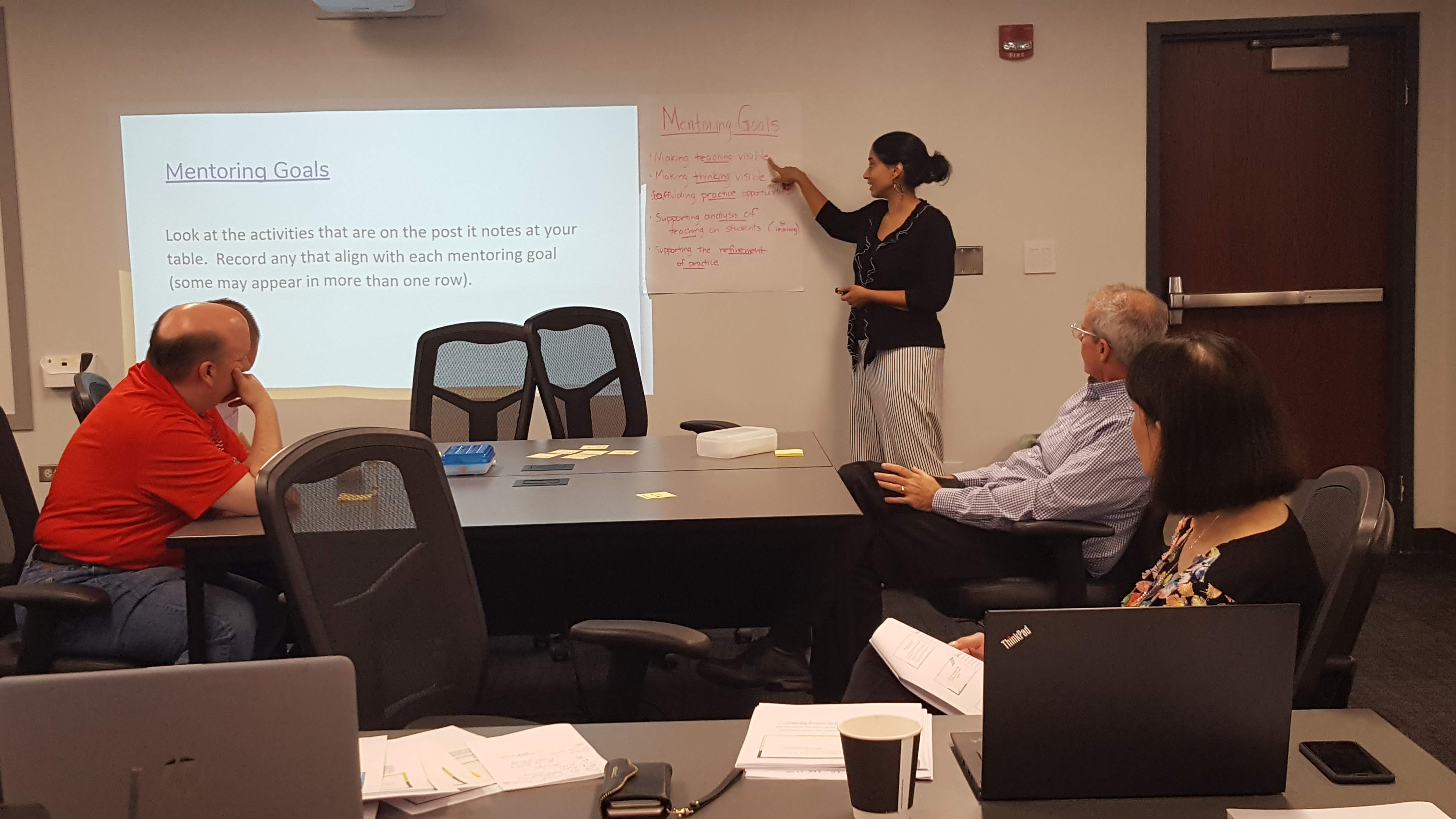
Starting in the fall 2018, NCE partnered with Maine Township District 207 and Northwestern University to engage several of the district’s high school cooperating/mentor teachers in this work. Together, our institutions have provided time, space, and resources for these in-service teachers to learn best practices for mentoring pre-service teachers.
Mentor teacher Chris Peters, a social science teacher at Maine East High School, who is the faculty lead of the mentor student-teacher program in Maine Township, has noticed the success of the program on both ends of the spectrum: "I'm working on debriefs with each student individually. People seem to really like the program. The teacher mentors are saying this is the best student teaching experiences they have had and while student teachers are saying that their peers are envious of the experience they are gaining."
Sharing Mentoring Tips with Mentors
NCE has implemented Mentoring in the Moment strategies with candidates using techniques such as charting, thinking aloud, huddling, and repeated teaching. Informal feedback to date indicates that the participating mentor teachers feel that by reflecting and verbalizing on their own practice, they also are becoming stronger teachers themselves – a sentiment that is also backed by recent research done on the same subject (Ronfeldt, Bardelli, Brockman and Mullman, 2019). NCE has witnessed this similar trend in surveys to all of our cooperating teachers where 100% of respondents indicated that they Agreed or Strongly Agreed that serving as a cooperating teacher impacted their professional growth in content knowledge and/or skills.
In an effort to support our cooperating/mentor teachers more broadly, in January 2019 NCE kicked off the first of our now quarterly Mentoring Matters session. These voluntary online Zoom development sessions are offered to all cooperating/mentor teachers hosting an NCE student teacher from across our Early Childhood, Elementary, Middle Grades, Secondary, and Special Education programs. The Office of Field Experience and Teacher Preparation faculty designed these to provide an opportunity for mentor teachers to meet NCE faculty and ask top-of-mind questions about our clinical experience requirements, and engage these field partners in discussion around key NCE program initiatives and mentoring strategies.
Mentor-Student Relationship Research
As part of an ongoing NLU-sponsored research project, several NCE faculty and staff including Dr. Sherri Bressman, Dr. Eun Ko, Lisa Mozer, and Dr. Jeff Winter, with Dr. Kavita Matsko at Northwestern University (former NCE leadership) interviewed a small group of teacher candidates and mentor teachers to better understand how they establish that relationship and what each role's relative expectations were of the clinical experience. Interestingly, the research findings suggested they hold opposing perspectives: mentors prioritizing more personal relationship building exchanges compared to candidates valuing instructionally focused exchanges instead. This work, the team hopes, leads to new approaches for teacher educators to prepare teachers for their role as mentors. These findings have been presented at both the Association of Teacher Educators (ATE) and the American Association of Colleges for Teacher Education (AACTE) annual meetings, and the team plans to publish in the near future.
Mentor Curriculum Development
Through the accomplishments of these initiatives, NCE is working towards creating its own Mentor Development curriculum – one that involves continued engagement with our cooperating teachers, multiple touch points throughout one’s field experience, and support structures and resources for mentoring strategies. This curriculum would be utilized to build out the current in-service educator coaching methods in NCE’s teacher and leadership preparation programs, in particular for the MAT teacher residency program and its supervisor role called Residency Field Coach or ‘RFC’. The goal for this role will not only be to supervise the resident teacher candidate, but also to guide the resident’s Mentor Teacher on how to best give the candidate real time feedback day to day. The RFCs would complement any district-led training as well: for instance, with residency district partner Chicago Public Schools, their Mentor Teachers would also attend ongoing training provided through the CPS Office of Teaching and Learning, Teacher Leader Development and Innovation.
For more information, please contact Lisa Mozer, Director, Office of Field Experiences and PK-12 Partnerships at lisa.mozer@nl.edu, Dr. Sherri Bressman, Director, Teacher Preparation at sbressman@nl.edu , or Dr. Kavita Venkatesh, Director of Residency and Alternative Pathway Programs at kvenkatesh@nl.edu.