
Thought Leadership Guidance
At NLU, thought leadership (TL) is incorporated into professional practice and tenure tracks and is optional for the teaching track. The inclusion of thought leadership opportunities across all tracks highlights the university's value in faculty expertise and knowledge creation, as outlined in the 2030 Strategic Plan, which calls for us to be thought leaders in teaching, modeling, and disseminating scholarship on emerging practices and technologies that support learners and promote their success.
This page offers guidance and tools to shape your thought leadership agenda, ensure it reflects both your goals and the university’s pathways to promotion, and put it into action. Click on the tabs below to learn more, and don't miss the FAQ at the bottom of the page.
Here’s a suggested sequence for using the resources offered here:
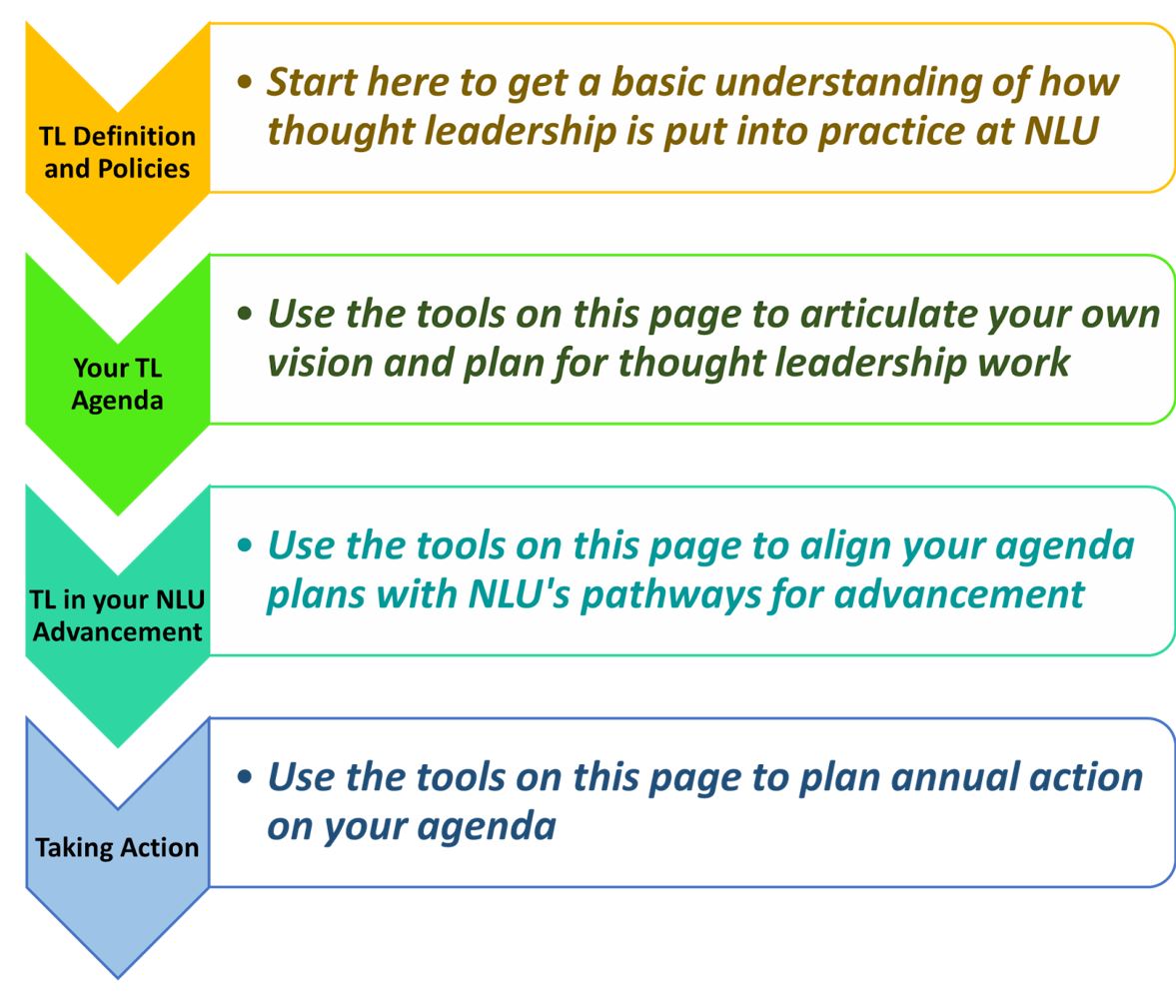
Thought Leadership Definition and Policies
NLU places equal value on knowledge that comes from discovery and from practice expertise. Both sources are encompassed in our definition of thought leadership: the sharing of findings and expertise to inform thought and action within the University and/or local, regional, national, and global communities.
At NLU, thought leadership can take place through two approaches:
- Development and sharing of a cohesive, externally recognized body of Engaged Research related to strength areas
- Development and sharing of an evidence base on innovation and accomplishment in professional practices.
Tenure track faculty are expected to use the first approach. Professional practice faculty more often use the second approach but also may use both approaches. Tenure and Professional Practice faculty are expected to disseminate their output externally via publications and presentations, although the amount differs and varies based on their rank.
Two policies specifically set out expectations and guidelines for faculty demonstration of thought leadership.
Faculty Policy 102, Full-Time Faculty Workload, delineates standard workload parameters. For thought leadership, FP 102 describes standard load allocation for thought leadership by track and contains a section offering guidance to faculty and leaders on estimating time for thought leadership activity.
Section 104 - Awarding Promotion, Tenure, and Multi-year Appointments defines the criteria and procedures for the initial assignment of rank, for promotion in rank, for the awarding of tenure, and for awarding multi-year contracts. For thought leadership, FP 104 defines the criteria for evaluating the demonstration of thought leadership and the expectations of performance in thought leadership for each faculty track and at each stage of promotion and tenure award processes.
Your Thought Leadership Agenda
Your thought leadership agenda is a roadmap for advancing your scholarship or expert practice over the next three years. It supports you in defining your focus, outlining projects, and setting annual goals that align with NLU’s priorities and your own professional aspirations. The agenda is meant to be dynamic—a living document that evolves as work progresses. It acts as your personal guide, provides the foundation for requesting thought leadership load hours, and creates information you can use in the faculty performance evaluation process.
The University suggests that you update your TL agenda each year when setting goals for the next academic year. Typically, this happens between March and June 30. An up-to-date TL agenda helps you and your supervisor organize your intended TL activity for the upcoming year and appropriately allocate workload to it.
Below, you’ll find the template to create your agenda and a PowerPoint guide with step-by-step directions and examples to support you in completing it.
For additional guidance, you are also encouraged to consult others, including your program chair, dean, fellow faculty members, or designated mentor. They can provide support and feedback to ensure that your agenda reflects your priorities, is realizable, and aligns with college and university goals.
Thought Leadership in Your NLU Trajectory
With faculty input, the Provost’s Office and key committees have developed quantitative thought leadership indicators and thresholds for promotion.
Aligning your thought leadership plans with NLU expectations for productivity is an important step even if you’re not currently considering an application for promotion. It supports you in achieving success in your performance and/or goal reviews and builds meaningful conversations on your thought leadership trajectory with mentors and your college leadership.
If you are currently planning for promotion, an essential consideration: The quantitative thresholds linked on this page should be seen as a component, rather than a summation, of a promotion dossier that richly describes how a faculty member has built and disseminated expertise in one or more of NLU’s areas of strength in research and practice. The focus of dossier reviews will continue to be on the impact of your work. For full information on planning for the dossier, please refer to a comprehensive resources on the Promotion and Tenure Support page. It is also highly recommended that during dossier preparation, you attend the support workshops that are offered annually.
The following resources are here to help you ensure that your thought leadership plans align with the University's expectations for productivity. Here’s how to use these resources:
Start with the Indicators: The Thought Leadership Indicators table shows what “counts” as thought leadership output. Having clearly defined, aligned outputs will strengthen your requests for loads, performance evaluations, and potential promotion dossiers. As you may have done when you planned your thought leadership agenda, use this table as a guide when planning projects and deciding on and describing outputs.
Check the Thresholds: The Promotion Thresholds table outlines the levels of output needed for each promotion stage. Review these benchmarks early, even if you’re not currently planning to apply, so you can pace your work across several years.
Consider the Timeline for Full Implementation of the Thresholds: These thresholds are being adopted in stages over a four-year timeline, from AY2024-25 - AY2027-28, to ensure that faculty currently in a promotion planning period have fair and adequate preparation time. Use this Implementation Timeline to ensure you know what expectations apply in your current promotion window if you plan to apply for promotion before AY2027-28. If submitting your dossier for promotion on September 1, 2027 (the 2027-28 promotion cohort), the phased implementation schedule will be complete and the published thresholds will take effect.
Taking Annual Action on Your Agenda Step 1: Aligning Your Agenda with Your Assigned Load
- Your Time Commitment—Begin by estimating the time required for each activity in your agenda and ensure it fits within your allocated load hours.
- Understand Load Expectations by Faculty Track
- Tenure Track Faculty: It is expected that Tenure track faculty plan thought leadership activities equal to 3 semester hours (150 clock hours) annually.
- Professional Practice Faculty: Thought leadership load is annually allocated to projects as needed based on the faculty member’s goals and expected outputs. Load may be less than 3 semester hours depending on the scope of the project and the needs of the college.
- Teaching Track Faculty: When engaged in thought leadership, follow the same process as Professional Practice faculty by negotiating load with the dean.
- Use the TL Activity Time Estimate Table to determine whether your planned activities reasonably fit within the load hours you are requesting or have been assigned.
Example
A tenure track faculty member with an expectation of 3 SH of thought leadership activity for the year might plan:
- Conduct a literature review on community-based literacy programs (30–40 hours)
- Collect survey data from two partner schools (40–50 hours)
- Carry out initial analyses of survey data (20-30 hours)
- Draft a conference proposal (20–30 hours)
Together, these activities fit within the expectations of the annual 3 SH load.
By following this process, faculty can ensure that their thought leadership agendas are actionable within their assigned responsibilities, appropriately resourced, and well-positioned for accurate reporting in performance reviews.
Taking Annual Action on Your Agenda Step 2: Report on Your Agenda in the Faculty Performance Evaluation (FPE)
Once your thought leadership agenda has been aligned with your annual load, the next step is to ensure that your activities and outputs are clearly documented in your Faculty Performance Evaluation (FPE). This process makes your progress visible and ensures that your contributions are recognized in annual performance and merit reviews.
- Connect Agenda to FPE Goals
- The activities you list in your thought leadership agenda become your Thought Leadership Domain goals in the FPE.
- Each year, copy the activities you planned into the FPE form so your agenda and evaluation are fully aligned.
- Track and Report Activities
- As the year progresses, keep a running record of what you have accomplished (e.g., literature reviews, data collection, partnerships built).
- At evaluation time, update your FPE with a brief, outcome-focused description of the work completed.
- Document Outputs
- Make sure to include your outputs, like a presentation, publication, grant submission, or community workshop, in your FPE.
- Use the language of the Thought Leadership Indicators where possible—this helps demonstrate how your outputs meet institutional criteria.
- Highlight Impact
- Go beyond listing tasks by emphasizing the impact of your work: how it advanced knowledge, supported partners, or contributed to the field.
- This is especially important for promotion and merit discussions, where impact carries significant weight.
Example
Agenda Activity: Recruit partner schools and collect survey data on bilingual family engagement practices.
FPE Reporting: Established partnerships with two schools; successfully collected survey data from 75 families, which will inform analysis for an upcoming conference presentation.
For further details and guidance on completing the FPE, please refer to the Promotion and Development Support page.
By linking your agenda to the FPE in this way, you create a clear through-line from your planning to your evaluation. This not only supports annual merit raises but also builds a strong foundation for long-term promotion planning.
Thought Leadership FAQs:
How do the thought leadership output expectations relate to load?
A: Tenure track faculty will continue to receive 3 semester hours for thought leadership with the expectation that their thought leadership output shows progress and achievement as the faculty member has laid out in their thought leadership agenda. Frequent inconsistent progress could impact a tenured faculty member’s load allocation for thought leadership.
Professional practice track faculty should use the thought leadership agenda to develop annual thought leadership goals. Unlike the Tenure track, thought leadership load is not guaranteed for the Professional Practice track but is negotiated annually based on the faculty member’s thought leadership goals for the year. Deans will determine an appropriate amount of load to allocate to thought leadership based on the expected outputs for the year. In some cases, the allocation might be less than 3 semester hours.
If and when teaching track faculty engage in thought leadership, they should follow a similar course of action as professional practice track faculty to negotiate load for their engagement of thought leadership.
Does meeting a threshold, for example the listed number of academic publications, mean that expectations are satisfied, or would there still be evaluation of the narrative and evidence related to that criterion?
A: As is the case now, the evidence and narrative should be provided and would be evaluated. These figures should be considered a component, rather than a summation, of a promotion dossier that richly describes how a faculty member has built and disseminated expertise in one or more of NLU’s areas of strength in research and practice. A clear statement of the purpose of the work, discussion of how research or expert practice is enacted, and evidence of impact are all part of the full picture of thought leadership. The CTLE website has materials and guidelines to support building the dossier.
Are the expectations the same across tracks?
A: While FP 104 places thought leadership in both the professional practice and tenure tracks, the level of expected participation and outcomes differs by track. The tracks share a common base of the commitments seen in the NLU statement of scholarship while responding to the appropriately differentiated performance criteria in FP104. Additionally, the teaching track does not include expectations of thought leadership output. This does not preclude faculty on the teaching track from producing thought leadership outputs. If a teaching track faculty member engages in thought leadership work, they should set appropriate goals to guide that work using the identified thought leadership outputs and promotion thresholds.
Please refer to the Promotion Thresholds table for information on promotion expectations for thought leadership activity by track.
How will these indicators be applied for faculty who are not in a promotion process?
A: To support faculty ownership of their thought leadership work, the Provost’s office has developed a template (i.e., Thought Leadership Agenda) for defining a research/expert practice agenda that lays out the purpose, topics, and expected impacts of scholarship and/or expert practice over a three-year period. On an annual basis, review of progress towards/achievement of Thought Leadership Agenda output will be integrated into the FPE process.
As with all components of the FPE, thought leadership outputs would be a part of determining merit raises and might impact the level of research load given. As is the case with the entire FPE process, the review of outputs will not in any way impact faculty members’ track or rank, or in any way function as a post-tenure review to remove tenure.
FP 104 defines thought leadership in part as ‘Provide thought leadership at the University and/or local, regional, national, and global communities.’ To what extent can internal work meet the thought leadership thresholds?
A: As the Promotion Thresholds Table shows, while internal work is an essential component of thought leadership, the promotion thresholds require the majority of dissemination to be external. This is for two reasons: to enact NLU’s commitment to serving our communities and stakeholders and to reach the 2030 Strategic Plan goal of raising the distinctiveness of NLU and recognition of its thought leadership in teaching and learning. However, it’s expected that faculty engage the external community when disseminating their thought leadership.
Will the university place greater value, or importance, on any of the output categories or indicators?
A: All categories are integral to thought leadership, and evaluation will be of a promotion dossier that richly describes how a faculty member has built and disseminated expertise in one or more of NLU’s areas of strength in research and practice. The thresholds are components rather than a summation, and a promotion dossier should evidence their importance and impact on the field and National Louis University and/or regional, national, and global communities. That being said, given the 2030 strategic plan goal to raise the University profile as thought leaders in higher education, there is more importance on external thought leadership outputs. A faculty member will not be able to satisfy expectations by only producing internal outputs.
Does thought leadership engagement and output impact a teaching track faculty member’s case for rank promotion?
A: Teaching track faculty do not have an expectation of thought leadership output, and if they do not engage in thought leadership, it will not have an impact on their promotion application. If they engage in thought leadership, they should include in their promotion dossier evidence and explanation of the thought leadership outputs and outcomes achieved. As is the case with all goals set as part of the annual performance evaluation, if thought leadership goals are set and not reached, the committees and stakeholders engaged in the promotion process will consider these shortcomings when evaluating their application for promotion.
What is the relationship between the Thought Leadership expectations and increasing Tenure track opportunities for faculty?
A: Defining the expectations for thought leadership output by track intends to support faculty and administrators in building shared views of thought leadership effort and achievement that can inform future tenure opportunities. With a shared, aligned view of the Tenure track’s thought leadership expectations, administrators and faculty will have clarity about the type and amount of thought leadership expected to achieve tenure.
