Promotion and Tenure Support
National Louis University’s ability to accomplish its mission depends on the quality of the teaching it delivers to students and on the research and other contributions it makes to the disciplines, professions, and communities with which it engages. This quality of performance depends in turn on the quality of the University’s faculty.
Every member of the University’s full-time faculty receives both rank and appointment to either a Tenure Track, a Professional Practice Track, or a Teaching Track position. In addition to being eligible for promotion in rank, Tenure Track faculty may be awarded tenure (continuing full-time employment with the University, subject to the University’s terms and conditions) and those on the Professional Practice and Teaching Tracks may be eligible for multi-year appointments.
Promotion and Tenure Resources
To apply for promotion or tenure, faculty need to submit a dossier that summarizes their work. We know that submitting a dossier for promotion or tenure can be a stressful endeavor. Whether it's technological challenges, concerns of inadequacy, or just finding what needs to be submitted, we're here to help.
The Provost Office and IPTRC will convene a kick-off meeting in June to discuss the process and provide access to SharePoint. We will also offer regularly scheduled Q&A sessions to help you understand the process and work through building your dossier. If you have questions or want to schedule a 1-on-1 session, please contact Jon Oelke, the Director of Faculty Engagement and Development, at joelke@nl.edu.
Deciding to Apply
April – June: The Chief Academic Officer notifies all candidates in the various stages of the promotion and tenure process of their status and eligibility and works with IPTC to offer informational workshops for candidates (their attendance is voluntary).
May 22nd @ 1pm (CST): Promotion Info Session - Register Here
By June 1: All candidates who intend to apply in September for promotion, early tenure, and/or tenure must submit a Notice of Intent to Apply for Promotion form.
Building the Dossier
Promotion Support Kickoff Session: Wednesday, June 10th @ Noon (CST). Invites sent to applicants the week of June 1st.
By June 15: The Chief Academic Officer advises the full faculty of the names of all candidates and invites submission of written comments, which must be received by the same deadline as that for receipt of dossiers.
Support Sessions: Every other Tuesday @ Noon (CST), beginning June 16th. Invites sent to applicants the week of June 1st.
By September 1st at 11:59 pm – The dossier and support documents must be uploaded to the designated faculty folder and sub-folders on the Promotion and Tenure SharePoint site. NO EXCEPTIONS.
Deliberation
By October 1: Deans submit initial letters of recommendation to the Chief Academic Officer, who makes the Dean’s letter and all internal and external letters available to the College and Institutional Promotion Committee members for review.
By November 1: College committees complete their review of all candidate dossiers and submit formal written recommendations to the Chief Academic Officer, who makes them available to IPTRC.
By February 15: IPTRC completes its review of all candidate dossiers and college committee recommendations and submits its formal written recommendations to the Chief Academic Officer.
By April 1: The Chief Academic Officer submits his/her recommendation and brief rationale on each candidate to the President. The President reviews and, with the CAO, prepares their written recommendation for each candidate for the Board of Trustees.
By June 30: The Board of Trustees acts on the recommendations submitted.
Decision
Within 10 days of the June Board meeting, the Chief Academic Officer notifies each candidate via formal letter of the Board’s action and of action to be taken the following year, pursuant to the granting or denial of promotion or tenure. The Chief Academic Officer then announces the names of successful candidates to the Faculty Senate and the University community.
Within 45 working days after Board of Trustees action: Any candidate wishing to appeal a Board decision must file such appeal, pursuant to Faculty Policy 112 on Promotion and Tenure Appeals.
|
Professional Practice Track |
Years in Rank |
|---|---|
|
Instructor of Practice |
3 years |
|
Assistant Professor of Practice |
4 years |
|
Associate Professor of Practice |
5 years |
|
Teaching Track |
Years in Rank |
|---|---|
|
Teaching Instructor |
3 years |
|
Assistant Teaching Professor |
4 years |
|
Associate Teaching Professor |
5 years |
|
Tenure Track |
Years in Rank |
|---|---|
|
Assistant Professor |
4 years |
|
Tenure Review |
5 years* |
|
Associate Professor |
5 years |
*Tenure review occurs after 5 years on the Tenure Track
Getting to SharePoint
-
- SharePoint online can be accessed using the following link: https://mynl.sharepoint.com/sites/PromotionandTenure
Below is a summary of what should be included in your Promotion/Tenure review folder. Italicized items are folders that will house multiple documents.
- Narrative
- CV
- Proof of Terminal Degree
- Midway Tenure Review (Tenure Track Only)
- Teaching Excellence Evidence
- Service Evidence
- Thought Leadership
- Course Evaluations
- Letters of Recommendations
CV Guidandce
A CV can serve as your introduction to dossier reviewers. When building your CV, the IPTRC recommends including the following sections:
- Education
- Licenses and Certifications
- Teaching Experience
- Research Publications
- Other Publications
- Presentations
- Leadership
- Grants (awarded or worked on)
- Awards
File Naming Format
Organization and consistency in file names are the main theme here. Also, when referencing support evidence in your narrative, include the document title as it appears in SharePoint. This ensures reviewers can easily identify documents as they navigate through the digital dossier and locate support documents.
Candidates must use the following format for naming files uploaded to SharePoint:
Teaching Excellence Folder:
- 01.TeachingExcellence.DocumentTitle
- 02.TeachingExcellence.DocumentTitle
- Etc.
Service Folder:
- 01.Service.DocumentTitle
- 02.Service.DocumentTitle
- Etc.
Thought Leadership Folder (If on Thought Leadership or Professional Practice Track):
- 01.ThoughtLeadership.DocumentTitle
- 02.ThoughtLeadership.DocumentTitle
- Etc.
Notes:
- SharePoint orders the files in each folder by the first letter or number.
- Number the documents in the order in which they appear in your narrative.
Linking to Evidence in SharePoint
-
- You can link to evidence in SharePoint to make your dossier easier for reviewers to navigate. Please see the video here for how to provide links to your evidence in your narrative.
Single Document
Your dossier narrative should be in a single document divided into sections that match the domains (i.e. Teaching Excellence, Service, and Thought Leadership) in which the faculty member is expected to contribute. Please use sub-headings within each of the sections to organize the narrative. Possible sub-sections are detailed below.
Format
Font size should be readable; 12-point Times New Roman is preferred. Margins must be equal to or greater than 0.75 inches on all sides
Evidence/Support documents
- All evidence and supporting documents must be submitted electronically to the Promotion and Tenure SharePoint site. If an electronic file is not available, documents will need to be scanned, saved as a PDF file, and then uploaded.
- Select the most relevant support and evidence documents that support your outcomes in each domain. This is your only opportunity in the process to advocate for yourself; it is important to demonstrate to the reviewers how your outcomes within each criteria of each domain address the promotion and tenure policy.
- Use your narrative to connect the support documents and summary charts to clearly address the criteria for each section and organize the documents in a clear and coherent manner in each of the folders.
Evidence to Include
Your dossier should only contain activities and supporting documentation from your appointment to your current rank.
Accomplishments and outcomes during previous ranks or positions can also be featured to provide context and illustrate progress and growth but this is not necessary. Accomplishments made when you held a different rank or role at the University do not count toward your promotion to the next rank. For example, if you made accomplishments at NLU while you held the assistant professor rank and you depict and discuss those accomplishments in your dossier for promotion to the professor rank, these accomplishments serve to establish context but will not be considered by shared governance when deliberating on your promotion to the professor rank, since they already counted toward your promotion to the associate professor rank.
- A narrative addressing each criterion within each domain is required.
- You must argue that you have accomplishments for each domain criterion that have been impactful.
- You SHOULD use the criteria to organize the narrative.
- You should use both qualitative and quantitative evidence to articulate the impact of your accomplishments.
- The narrative must explain the included evidence and argue how the evidence is impactful.
- You should focus on accomplishments and outcomes from the years in your current rank. Accomplishments and outcomes during previous ranks can also be featured to provide context and illustrate progress and growth, but this is not necessary, and accomplishments made when you held a different rank or role at the University do not count toward your promotion to the next rank. For example, if you made accomplishments at NLU while you held the assistant professor rank and you discuss those accomplishments in your dossier for promotion to the professor rank, these accomplishments serve to establish context but will not count toward your promotion to the professor rank, since they already counted toward your promotion to the associate professor rank.
- You must argue that you have accomplishments for each domain criterion that have been impactful.
- Include an introduction to how your work has made an impact on students, NLU, and the community. Essentially, the introduction acts like your thesis statement for your dossier.
- Teaching Excellence Narrative - Make a persuasive argument using quantitative and qualitative data to explain how your accomplishments have made an impact on students (i.e., advance student outcomes such as retention, graduation, and/or employment and their growth as an educator in higher education)
- Include evidence that addresses each criteria within the Teaching Excellence Domain and organize your argument using the criteria. It’s recommended that you use criteria as sub-headings, then argue using evidence that your accomplishments have made an impact.
- Service Excellence Narrative - Make a persuasive argument using quantitative and qualitative data to explain how your accomplishments have made an impact on your program, college/unit, and NLU.
- Include evidence that addresses each criteria within the Service Domain and organize your argument using the criteria. It’s recommended that you use criteria as subheadings, then argue using evidence that your accomplishments have made an impact.
- Thought Leadership Narrative (Tenure or Professional Practice Track Requirement) - Make a persuasive argument using quantitative and qualitative data to explain how your accomplishments have made an impact on your field or discipline and/or the reputation of NLU.
- For detailed descriptions of requirements for Thought Leadership, please review the Thought Leadership Guidance page. Specifically, the tab titled "Thought Leadership in Your NLU Trajectory" will link to resources that will help guide you.
- Summary and final case for earning Promotion/Tenure
We have pulled together a sample narrative to help you get started. This sample demonstrates how to effectively lay out your dossier by:
- Addressing each criterion within each domain.
- Referencing evidence for each criterion.
- Explicitly highlighting the impact of the work being done—whether for students, NLU, or themselves.
Sample Promotion Dossier Word Doc
- Note that this narrative lists Thought Leadership. This is not a requirement for faculty on the Teaching Track, but Thought Leadership accomplishments can be listed to demonstrate impact above and beyond Teaching Track expectations.
- Note that this IDEA score discussion highlights supportive AND critical feedback from students. The faculty member highlights their ability to respond to student feedback by adapting their pedagogy.
Letters of Recommendation
You may request internal or external letters of recommendation to support your dossier. Letters of recommendation should be addressed in the narrative. Ideally, a letter of recommendation will speak to a domain or even a particular criterion within a domain. This may not be possible, however, if the letter is submitted after the September 1 deadline. For this reason, we recommend that you ask letter writers to submit their letters by August 15th. Please ask your letter writers to submit their recommendation letters to PT@nl.edu. The Provost's Office will upload them to SharePoint on your behalf.
Should a letter of recommendation be requested from a faculty member sitting on a college promotion committee or the Institutional Promotion Tenure and Recognition Committee, the committee member will be asked to recuse themselves from the deliberation process. Their letter serves as their advocacy for the candidate throughout the process. For additional information, see the Committee Recusal Guidance accordion for more details.
Reference Letter Parameters
- Although there’s no limit on the number of letters of recommendations a candidate can submit, there are diminishing returns on too many submissions. IPTRC recommends the following limitations. You are not expected to submit 10 letters of recommendation; in fact, successful dossiers have included as few as three or four letters of recommendation. Below are recommended maximums.
- No more than two (2) reference letters per domain.
- In addition to the two (2) reference letters for each domain, no more than four (4) general letters speaking to work quality/character may be submitted.
- Reference letters need to be anchored to a specific criterion within the domain and addressed as such in the narrative.
Regarding Deans
- Deans will be reviewing your dossier and submitting a letter as to whether or not they recommend your promotion.
- Be sure that you're on the same page with your Dean regarding your promotion timing. I.e., have a chat with them to discuss whether they feel like you've met all criteria and are ready to seek promotion.
- It's not necessary to seek a letter of recommendation from a Dean, since they are part of the shared governance decision-making.
Thought Leadership in Your NLU Trajectory
With faculty input, the Provost’s Office and key committees have developed quantitative thought leadership indicators and thresholds for promotion.
Aligning your thought leadership plans with NLU expectations for productivity is an important step even if you’re not currently considering an application for promotion. It supports you in achieving success in your performance and/or goal reviews and builds meaningful conversations on your thought leadership trajectory with mentors and your college leadership.
If you are currently planning for promotion, an essential consideration: The quantitative thresholds linked on this page should be seen as a component, rather than a summation, of a promotion dossier that richly describes how a faculty member has built and disseminated expertise in one or more of NLU’s areas of strength in research and practice. The focus of dossier reviews will continue to be on the impact of your work.
The following resources are here to help you ensure that your thought leadership plans align with the University's expectations for productivity. Here’s how to use these resources:
Start with the Indicators: The Thought Leadership Indicators table shows what “counts” as thought leadership output. Having clearly defined, aligned outputs will strengthen your requests for loads, performance evaluations, and potential promotion dossiers. As you may have done when you planned your thought leadership agenda, use this table as a guide when planning projects and deciding on and describing outputs.
Check the Thresholds: The Promotion Thresholds table outlines the levels of output needed for each promotion stage. Review these benchmarks early, even if you’re not currently planning to apply, so you can pace your work across several years.
Consider the Timeline for Full Implementation of the Thresholds: These thresholds are being adopted in stages over a four-year timeline, from AY2024-25 to AY2027-28, to ensure that faculty currently in a promotion planning period have fair and adequate preparation time. Use this Implementation Timeline to ensure you know what expectations apply in your current promotion window if you plan to apply for promotion before AY2027-28. If submitting your dossier for promotion on September 1, 2027 (the 2027-28 promotion cohort), the phased implementation schedule will be complete and the published thresholds will take effect.
Summary Charts
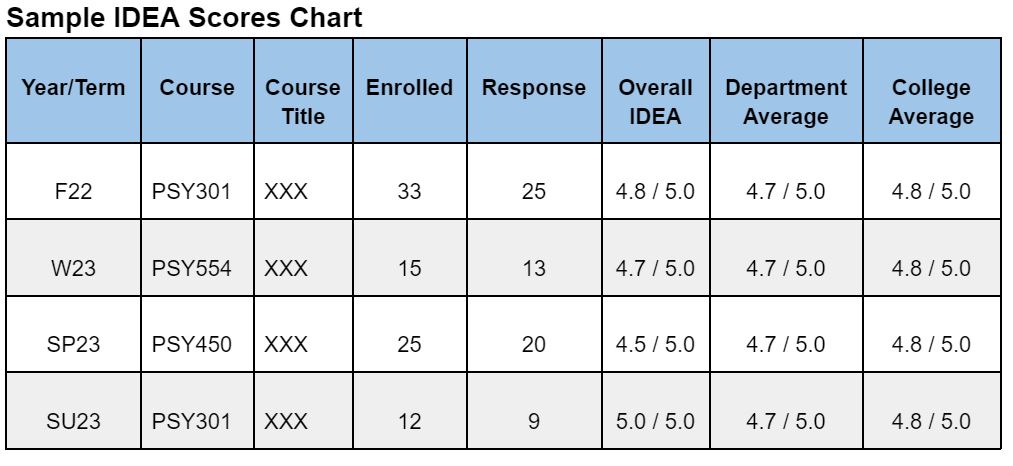
It is recommended that you create a chart (or charts) to summarize your outcomes and accomplishments during your time in your current rank. When using charts:
- Include a description of each chart in your narrative.
- Use the data in the chart to help make a persuasive argument to explain how your accomplishments have made an impact on students, the program, college, NLU, or the community.
- Reference relevant supporting evidence.
Accomplishments and outcomes during previous ranks can also be featured to provide context and illustrate progress and growth but this is not necessary and accomplishments made when you held a different rank or role at the University do not count toward your promotion to the next rank. For example, if you made accomplishments at NLU while you held the assistant professor rank and you depict and discuss those accomplishments in your dossier for promotion to the professor rank, these accomplishments would serve to establish context but will not count toward your promotion to the professor rank since they already counted toward your promotion to the associate professor rank.
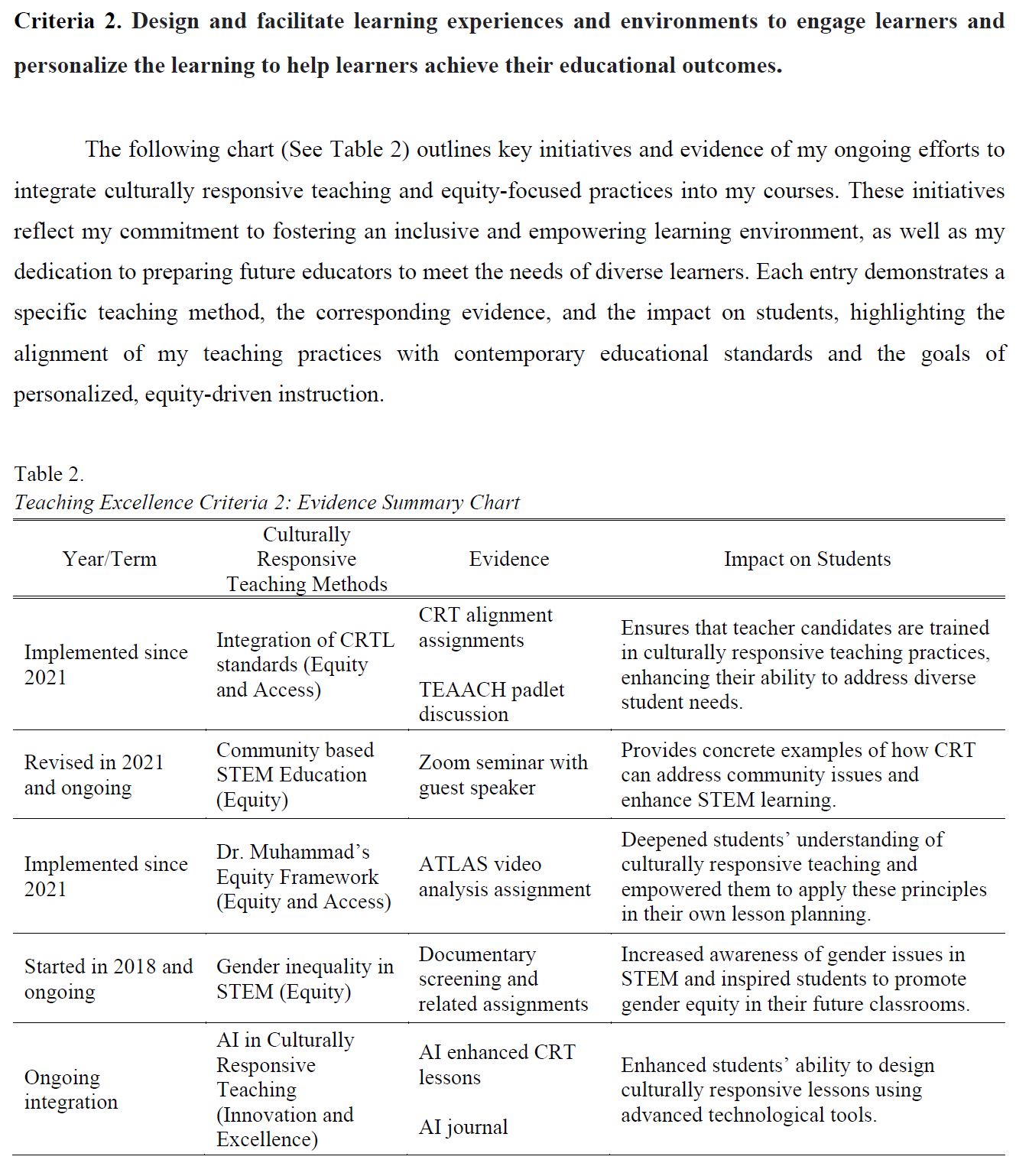
Sample Teaching Excellence Table
The faculty member introduces the chart and explains the impact of their work in the following section.
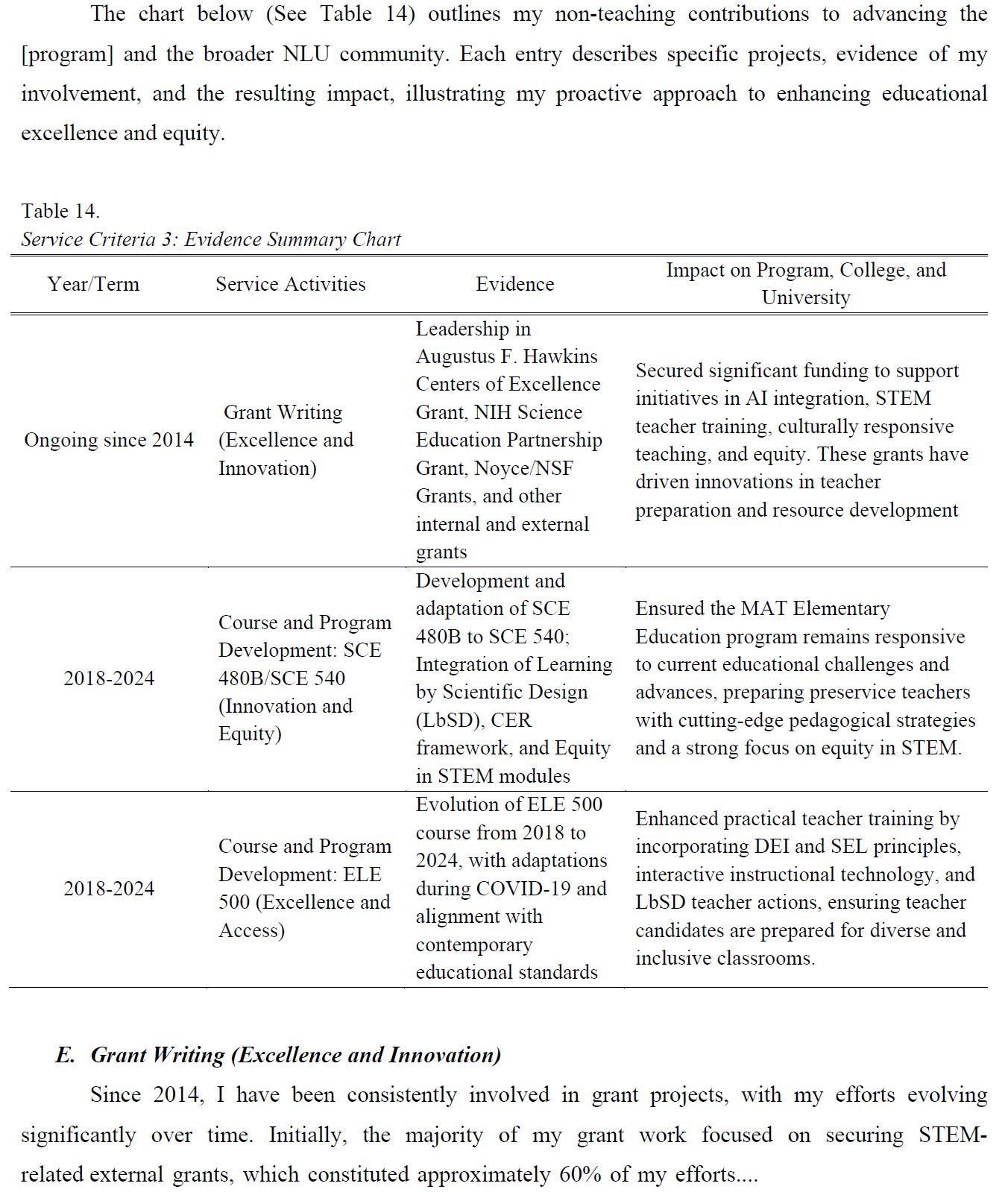
 Sample Service Table
Again, the faculty member introduced the chart, which listed evidence, and then explained the work and its impact in the following section.
Sample Thought Leadership Table
Great use of a table to summarize Thought Leadership evidence. This approach may make it easier for reviewers to understand the depth and scope of your research, rather than referring them to your CV.

Guidance on Recusal for Promotion Committee Members
To uphold the integrity and fairness of the faculty promotion process, committee members who have authored a letter of recommendation in support of a promotion candidate must recuse themselves from all deliberations related to that candidate’s application.
What Recusal Entails:
- Committee members authoring letters of recommendation for a candidate should not be assigned to review that applicant’s dossier and should remove themselves from making a recommendation for the candidate’s outcome.
- Committee members must exit the Zoom call or leave the physical room during both discussion and voting for the candidate they supported.
- Members may not participate in informal discussions or provide additional commentary about the candidate during the committee’s review process.
Why This Matters:
- Recusal in these cases helps to avoid conflicts of interest and ensures that the committee’s review process remains impartial and transparent.
- This standard applies regardless of committee size or voting structure and aligns with best practices in faculty evaluation.
If You Have Questions:
- If you are unsure whether your involvement with a candidate requires recusal, please consult with the Office of the Provost prior to the meeting.
Thank you for your commitment to a fair and equitable promotion process.
Example Activities for Domain Criteria
The Provost Office and Faculty Development Committee collaborated to generate example activities that align with criteria for the Teaching Excellence, Service, and Thought Leadership domains. These examples are meant to prompt one’s thinking about where various activities might align with the criteria. These activities are not exhaustive, meaning you may have engaged in activities that are not represented.
Remember that you must argue that your accomplishments have been impactful for each domain’s criteria.
The goal is to make a persuasive argument using quantitative and qualitative data to explain how your accomplishments have made an impact on students (i.e., advance student outcomes such as retention, graduation, and/or employment and their growth as an educator in higher education)
To do this, you will want to include evidence that addresses each criteria within the Teaching Excellence Domain and organize your argument using the criteria. It’s recommended that you use criteria as sub-headings, then use evidence to argue that your accomplishments have made an impact. Each candidates accomplishments will vary based on the focus of their efforts. Here, you will find some common activities that faculty list in their performance evaluation or promotion dossiers. These examples are meant to prompt one’s thinking about where various activities might align with the criteria. These activities are not exhaustive, meaning one may have engaged in activities that are not represented.
- Demonstrate the ability to remain current and connected in one's field or discipline and help students acquire the up-to-date knowledge, skills, and dispositions to acclimate to the discipline's professional practice.
- Teaching strategies in specific courses
- Development of new teaching materials.
- Attending conferences
- Reading books & articles
- Participating in association meetings and professional communities
- Choosing new texts for courses
- Attending workshops, webinars, or additional courses
- Leading or participating in PD with colleagues
- Work toward a degree, certificate, or license
- Research, including action research
- Participation in instructional coaching cycle
- Design and facilitate learning experiences and environments to engage learners and personalize the learning to help learners achieve their educational outcomes.
- Program/Course design (new developments and revisions)
- Development of new teaching materials, including videos, worksheets, activities, etc.
- Participation and/or presentation in workshops, seminars, and professional meetings devoted to improving teaching skills
- Peer evaluation and peer observation
- Student feedback on their learning experience (informal email or IDEA survey)
- Note on supporting student scholarship: Supporting students in scholarship that is required for a degree, such as the completion of a dissertation or capstone inquiry project, is a component of teaching excellence. Supporting students in thought leadership that is not encompassed within specific degree requirements, such as publication in academic journals, is activity within the domain of thought leadership.
- Create a safe, inclusive, equity-minded, and student-centered learning community where each individual student can succeed.
- Participation and/or presentation in workshops, seminars, and professional meetings devoted to improving teaching skills
- Participation in instructional coaching cycle
- Volunteering at study tables, THRIVE, and clubs
- Co-created classroom norms
- Above and beyond supporting students with accommodations
- Student meetings and office hours
- Student feedback on their learning experience (informal email, comments or IDEA survey)
- Employ diverse, creative, or innovative teaching strategies and methods of student support that enhance student learning.
- Development of new teaching materials
- Participation and/or presentation in workshops, seminars, and professional meetings devoted to improving teaching skills
- Action research, responsive teaching strategies, and using formative feedback to drive instruction
- Above and beyond supporting students with accommodations
- Student meetings and office hours
- Student feedback on their learning experience (informal email, comments or IDEA survey)
The goal is to make a persuasive argument using quantitative and qualitative data to explain how your accomplishments have made an impact on students (i.e., advance student outcomes such as retention, graduation, and/or employment and their growth as an educator in higher education)
To do this, you will want to include evidence that addresses each criteria within the Service Domain and organize your argument using the criteria. It’s recommended that you use criteria as sub-headings, then use evidence to argue that your accomplishments have made an impact. Each candidates accomplishments will vary based on the focus of their efforts. Here, you will find some common activities that faculty list in their performance evaluation or promotion dossiers. These examples are meant to prompt one’s thinking about where various activities might align with the criteria. These activities are not exhaustive, meaning one may have engaged in activities that are not represented.
- Contribute and/or take leadership in the university’s and/or college’s shared governance model.
- University, College, or program-level contributions (Senate, College, Program standing committees, ad hoc committees)
- Contribute to the advancement of the program, college, and/or university through work on committees, councils, task forces, DEI initiatives, or strategic projects that are outside of shared governance.
- Serve on student recruitment groups
- Serve on employee recruitment and hiring efforts to fill vacancies
- Interest-based groups
- Starting programs
- Contribute to the advancement of the faculty member’s program, college, and/or university and its students through non-teaching efforts and projects.
- Service on assessment reports
- Admission file reviews
- Mentor and assist adjunct faculty teaching courses
- Engage the community as part of your professional activities, and highlight how this engagement impacts the NLU community or the communities NLU serves.
- Outside service such as paper reviews, educational material /course reviews, Grant research and writing, editorial positions, positions in professional organizations
- Volunteer work related to education or our student population
The goal is to make a persuasive argument using quantitative and qualitative data to explain how your accomplishments have made an impact on students (i.e., advance student outcomes such as retention, graduation, and/or employment and their growth as an educator in higher education)
To do this, you will want to include evidence that addresses each criteria within the Thought Leadership Domain and organize your argument using the criteria. It’s recommended that you use criteria as sub-headings, then use evidence to argue that your accomplishments have made an impact. Each candidates accomplishments will vary based on the focus of their efforts. Here, you will find some common activities that faculty list in their performance evaluation or promotion dossiers. These examples are meant to prompt one’s thinking about where various activities might align with the criteria. These activities are not exhaustive, meaning one may have engaged in activities that are not represented.
Faculty on the Teaching Track do not need to include this section in their dossier unless they have impactful accomplishments during their time in rank. Faculty on the Tenure Track should provide evidence of the generation, evaluation, and application of knowledge in their field and their dissemination of knowledge both internally and externally (Criteria #1). Faculty on the Professional Practice track should provide a record of accomplishment as practitioners (Criteria #2). Criteria guiding a faculty member's performance in this domain are below.
- Generate, evaluate, and apply findings regarding new and existing knowledge within one’s field.
- Disseminate research, expertise-based knowledge, or creative outputs relative to one’s field in multiple formats to various external audiences.
- Participate, attend or present at a conference
- Published/unpublished papers/cases
- Grant written, submitted, or funded
- Articles/manuscripts/book reviews
- Consulting
- Note on supporting student scholarship: Supporting students in scholarship that is required for a degree, such as the completion of a dissertation or capstone inquiry project, is a component of teaching excellence. Supporting students in thought leadership that is not encompassed within specific degree requirements, such as publication in academic journals, is activity within the domain of thought leadership.
- Provide thought leadership to local, regional, national, and global communities.
- Serve and take leadership roles in organizations of local, regional, national, and global communities
- Professional Membership
- Officer/Director on Board of professional organization
- Disseminate research, expertise-based knowledge, or creative outputs relative to one’s field in multiple formats to various external audiences.
- Demonstrate a significant record of accomplishment as a thought leader within one’s field or discipline.
- Disseminate research, expertise-based knowledge, or creative outputs relative to one’s field in multiple formats to external audiences.
- Participate, attend or present at a conference
- Published/unpublished papers/cases
- PD for the NLU community and/or local communities
- Provide thought leadership to local, regional, national, and global communities.
- Participate, attend or present at a conference
- Published/unpublished papers/cases
- Grant written, submitted, or funded in collaboration with local, re
- Consulting, Contract research, Policy Analysis
- Action research, new strategies in the classroom
- Participate, attend or present at a conference
- Disseminate research, expertise-based knowledge, or creative outputs relative to one’s field in multiple formats to external audiences.
Faculty Policy 104
Promotion and Tenure during the 2024–2025 Academic Year will adhere to the new FP104 Policy, which was approved by Faculty Senate on 5/19/2023 and by Faculty Association on 6/2/2023.
Promotion and Tenure Workshop
To help you navigate the promotion and tenure process, the Institutional Promotion and Recognition Committee, along with the Center for Teaching and Learning Excellence will host a series of drop-in sessions throughout the summer to support Promotion and Tenure candidates. These are optional sessions. You can also schedule a 1-on-1 with Jon Oelke (joelke@nl.edu)