
Faculty Performance Evaluation Support
National Louis University values its faculty and their interrelated roles as outlined in the faculty domains: Teaching Excellence, Service, and Thought Leadership. The faculty and the University collectively benefit from the individual faculty member’s achievement and development.
NLU’s faculty evaluations are intended to provide a rational, fair, and systematic process for facilitating professional growth and balancing individual and institutional goals. Further, performance evaluations are expected to form the basis for faculty’s dossiers in the promotion or tenure review process.
Faculty Performance Evaluation (FPE)
Our performance review process is designed to provide faculty a formative assessment relative to the progress on their annual goals. This process is meant to assist faculty in developing meaningful goals that support their growth and development as a faculty member and as a professional or researcher in their field of practice.
Head to my.nl.edu and click "My Services" in the slide-out window on the left side of the screen. There you will see an FPE button. Click that to launch your FPE. If you have questions about the performance evaluation process or the new tool, please reach out to the Center for Teaching and Learning Excellence: CTLE@nl.edu
As a reminder, the revisions to FP103 created a different cadence for reviews for some faculty. As a reminder, the cadence outlined in FP103 listed in the table below. Two important notes
- A faculty member at the associate professor/professor rank or their academic unit leader may request a faculty performance evaluation during an "off-cycle" year.
- Faculty who are not engaging in a full faculty performance evaluation are still expected to set and review their goals with their academic unit leader.
| Rank | Cadence of Evaluation |
|---|---|
| Instructor of Practice and Teaching Instructor | Annual |
| Assistant Professor of Practice, Assistant Teaching Professor, and Assistant Professor | Annual |
| Associate Professor of Practice, Associate Teaching Professor, and Associate Professor | Biennial |
| Professor of Practice, Teaching Professor, and Professor | Triennial |
For faculty completing a full faculty performance evaluation, the FPE Form Guidance page will walk you through the form and offer guidance on how to complete it. There are narrative and video resources on that page.
For those of you who are only setting and reviewing goals, please see the Goal Form Guidance page using the link above.
The sessions below provide an opportunity to get additional clarification and ask more direct questions. You can also reach Jon Oelke (joelke@nl.edu) to set up a 1-on-1 support session.
2026 Sessions
|
Faculty FPE Session 3/11 @ Noon (CST) |
Reviewer FPE Session 3/10 @ Noon (CST) |
|---|---|
|
Faculty FPE Session 3/18 @ Noon (CST) |
Reviewer FPE Session 3/19 @ Noon (CST) |
|
Faculty FPE Session 4/22 @ Noon (CST) |
Reviewer FPE Session 4/29 @ Noon (CST) |

2024 Q&A Session for Full FPE
2024 Goals-only FPE Q&A Sessions
2024 Session for FPE Reviewers
This year we will be transitioning to a custom-built, digital FPE form. It will be available for you on Wednesday, March 11. We’re excited for you to use the new form and hope it streamlines the process and saves you time. Below, you can find information about accessing it.
As a reminder, the changes to Faculty Policy 103 (FP 103) in AY23-24 may impact your FPE cadence. Everyone, regardless of rank, will still engage in goal setting. For more information, please review FP 103, which can be found on the Faculty Guidelines page.
Accessing the new FPE tool:
To access your FPE:
Log-in to the portal: my.nl.edu
1) Sign-in using your NLU credentials
2) Once logged in, click on My Services in the menu on the left side of the screen.
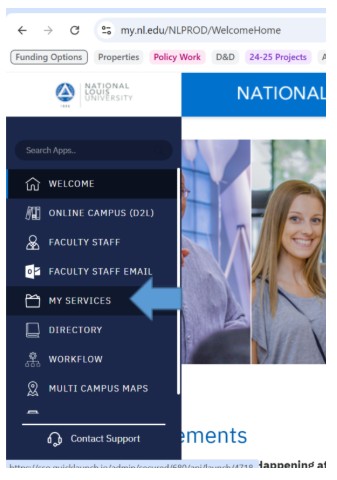
3) You will find an FPE Form button on the My Information tab. 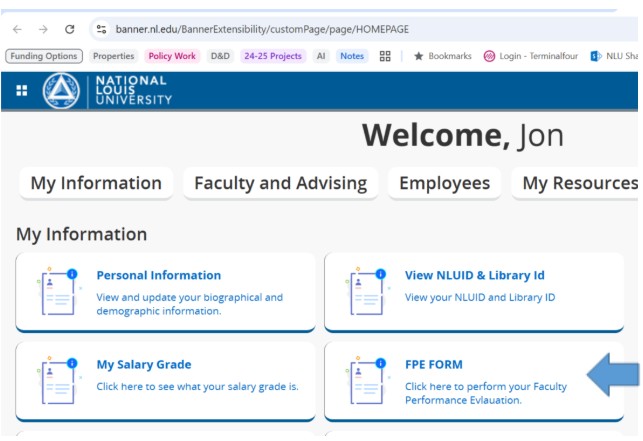
4) If you have questions or don’t see the FPE form, please reach out to Jon Oelke (joelke@nl.edu).
Recorded Support Session
Faculty Performance Evaluation Timelines
The Faculty Performance Evaluation cycle will be conducted starting on April 1st, and finish on June 30th. Below, you’ll find suggested deadlines to complete various tasks. Based on your and your reviewer’s schedule, each item may be completed sooner. The faculty member engaging in a full faculty performance evaluation and their reviewer should make contact by April 12th to determine the following:
- By what date will the faculty member upload their FPE form to SharePoint?
- By what date will the reviewer complete their review?
- When will the faculty member and reviewer(s) meet to discuss the faculty member’s work and progress?
The faculty member engaging in a goal-only review and their reviewer should make contact by April 12th to determine the following:
- By what date will the faculty member upload their goal form to SharePoint?
- When will the faculty member and reviewer(s) meet to discuss the faculty member’s goals?
Full Faculty Performance Review Timelines
Workload Form
Workload training videos can be found in the upper right corner of this page.
IDEA Scores
These will be added to your SharePoint folders by May 16th.
Self-evaluations
Faculty will upload FPE form by May 22nd, or by the date that works for you and your reviewer and allows for you both to complete your tasks before the June 12th deadline to finalize and submit the self-evaluation and reviewer forms.
One-on-one Meeting between Faculty and Reviewer
Faculty and reviewers use one-on-one meetings to discuss goals, ask questions, and create a plan to finalize feedback, goals, self-evaluation, and workload forms no later than June 12th.
Workload Form
Workload will be completed using the Workload Planning digital tool. Trainings held last year can be found in the upper right corner of the page. Submit draft workload for approval no later than June 12th.
The FPE Reviewer Guidance page will walk you through the FPE form and offer guidance on how to complete it and how to guide faculty through the process. There are narrative and video resources on that page.
The drop-in sessions below will allow you to get additional clarification and ask more direct questions. You can also reach Jon Oelke (joelke@nl.edu) to set-up a 1-on-1 support session.
Upcoming FPE Reviewer Q&A Sessions - Click to Register
Set-up Goal Review Meeting with Faculty
By April 14th, reviewers should reach out to faculty to schedule the one-on-one session, confirm that their reviewee has access to SharePoint and provide enough time for faculty to prepare for the meeting.
Set-up Review Meeting with Faculty
By April 14th, reviewers should reach out to faculty to schedule the one-on-one session, confirm that their reviewee has access to SharePoint folders, and provide enough time for faculty to prepare for the meeting.
Reviewer Feedback
Reviewers upload the FPE form with initial ratings and feedback at least 48 hours before one-on-one meeting.
One-on-one Meeting between Faculty and Reviewer
Faculty and reviewer use one-on-one meeting to discuss goals, ask questions and create a plan to finalize feedback, goals, self-evaluation, and workload forms no later than June 12th.
Reviewer Assignment
Academic Unit Leaders inform faculty of who will be conducting their review by March 31st.
Workload Assignment Review
Academic Unit Leaders review workload assignments with program chair by June 30th.
Goal Review and Alignment
Academic Unit Leaders review draft goals and align with workload assignments by June 30th.
Goals-only Review Timelines
Faculty should set goals for their expected contributions during the upcoming year, even if they are not scheduled for a full Faculty Performance Evaluation. This annual goal-setting will help faculty and reviewers communicate regarding shifting programmatic goals and faculty interests. It also provides an opportunity for faculty to check-in regarding long-term aspirations and short-term goals.
When setting goals, consider where progress in each domain fits within your career trajectory at NLU. For example: Do I have consistent practice in these criteria over a number of years? How will I demonstrate my accomplishments in these criteria for my promotion dossier?
As you set new goals each year, consider addressing criteria within each domain that you did not address during your previous review period.
A typical workflow for developing goals for the year will include: a faculty member drafts goals, sends those goals to their program chair/reviewer for review, the faculty member and reviewer will meet to finalize goals, and then the reviewer submits faculty goals to the Academic Unit Leader. However, this is only a recommended workflow; you and your reviewer may have a different process.
Workload Form
Workload training videos can be found in the upper right corner of this page.
Goal Form
Faculty will upload their goal form by May 22nd, or by the date that works for you and your reviewer and allows for you both to complete your tasks before the June 16th deadline to finalize and submit the self-evaluation and reviewer forms.
One-on-one Meeting between Faculty and Reviewer
Faculty and reviewers use one-on-one meetings to discuss goals, ask questions, and create a plan to finalize goals and workload forms no later than June 12th.
Workload Form
Workload will be completed using the Workload Planning digital tool. Trainings held last year can be found in the upper right corner of the page. Submit draft workload for approval no later than June 12th.
The FPE Reviewer Guidance page will walk you through the goal form and offer guidance on how to complete it and how to guide faculty through the process. There are narrative and video resources on that page.
Set-up Goal Review Meeting with Faculty
By April 14th, reviewers should reach out to faculty to schedule the one-on-one session, confirm that their reviewee has access to SharePoint and provide enough time for faculty to prepare for the meeting.
Reviewer Feedback
Reviewers may choose to offer feedback on faculty members' goals ahead of the meeting or during the meeting.
One-on-one Meeting between Faculty and Reviewer
Faculty and reviewers use one-on-one meetings to discuss goals, ask questions, and create a plan to finalize goals and workload forms no later than June 12th.
Reviewer Assignment
Academic Unit Leaders inform faculty of who will be conducting their goal review by March 31st.
Workload Assignment Review
Academic Unit Leaders review workload assignments with program chair by June 30th.
Goal Review and Alignment
Academic Unit Leaders review draft goals and align with workload assignments by June 30th.
Example Activities for Domain Criteria
The Provost Office and Faculty Development Committee collaborated to generate example activities that align with criteria for the Teaching Excellence, Service, Thought Leadership, and Academic Administration domains. These examples are meant to prompt one’s thinking about where various activities might align with the new criteria. These activities are not exhaustive, meaning one may have engaged an activity that’s not represented.
Note: The Academic Administration domain is only for faculty with load release for administrative duties.
- Demonstrate the ability to remain current and connected in one's field or discipline and help students acquire the up-to-date knowledge, skills, and dispositions to acclimate to the discipline's professional practice.
- Teaching strategies in specific courses
- Development of new teaching materials.
- Attending conferences
- Reading books & articles
- Participating in association meetings and professional communities
- Choosing new texts for courses
- Attending workshops/webinars/additional courses taken
- Leading/Participating in PD with colleagues
- Work toward a degree, certificate, or license
- Research, including action research
- Participation in instructional coaching cycle
- Design and facilitate learning experiences and environments to engage learners and personalize the learning to help learners achieve their educational outcomes.
- Program/Course design (new developments and revisions)
- Development of new teaching materials, including videos, worksheets, activities, etc.
- Dissertation/Thesis work with students
- Participation and/or presentation in workshops, seminars, and professional meetings devoted to improving teaching skills
- Peer evaluation, peer observation
- Student feedback on their learning experience (informal email or IDEA survey)
- Create a safe, inclusive, equity-minded, and student-centered learning community where each individual student can succeed.
- Participation and/or presentation in workshops, seminars, and professional meetings devoted to improving teaching skills
- Participation in instructional coaching cycle
- Volunteering at study tables, THRIVE, clubs
- Co-created classroom norms
- Above and beyond supporting students with accommodations
- Student meetings and office hours
- Student feedback on their learning experience (informal email, comments or IDEA survey)
- Employ diverse, creative, or innovative teaching strategies and methods of student support that enhance student learning.
- Development of new teaching materials
- Participation and/or presentation in workshops, seminars, and professional meetings devoted to improving teaching skills
- Action research, responsive teaching strategies, using formative feedback to drive instruction
- Innovative supports for students with accommodations
- Dissertation/Thesis work with students
- Student meetings and office hours
- Student feedback on their learning experience (informal email, comments or IDEA survey)
- Contribute and/or take leadership in the University’s and/or College’s shared governance model.
- University, College, or Program-level contributions (Senate, College, Program standing committees, ad hoc committees)
- Contribute to the advancement of the Program, College, and/or University through work on committees, councils, task forces, DEI initiatives, or strategic projects that are outside of shared governance.
- Serve on student recruitment efforts
- Serve on employee recruitment/hiring efforts to fill vacancies
- Interest-based groups
- Starting programs
- Contribute to the advancement of the faculty member’s Program, College, and/or University and its students through non-teaching efforts and projects.
- Service on assessment reports, admission file reviews
- Mentor and assist adjunct faculty teaching courses
- Engage the community as part of your professional activities, and highlight how this engagement impacts the NLU community or the communities NLU serves.
- Outside service such as paper reviews, educational material/course reviews, Grant research and writing, editorial positions, positions in professional organizations
- Volunteer work related to education or our student population
Faculty on the tenure track should provide evidence of the generation, evaluation, and application of knowledge in their field and their dissemination of knowledge both internally and externally. (Criteria #1). Faculty on the professional practice track should provide a record of accomplishment as a practitioner (Criteria #2). Criteria guiding a faculty member's performance in this domain are below.
- Generate, evaluate, and apply findings regarding new and existing knowledge within one’s field.
- Disseminate research, expertise-based knowledge, or creative outputs relative to one’s field in multiple formats to various external audiences.
- Participate, attend or present at a conference
- Published/unpublished papers/cases/instructional materials
- Grant written, submitted, or funded
- Co-publishing a thesis or dissertation with a student
- Articles/manuscripts/book reviews
- Consulting
- Provide thought leadership to local, regional, national, and global communities.
- Serve and take leadership roles in organizations of local, regional, national, and global communities
- Professional Membership
- Officer/Director on Board of professional organization
- Disseminate research, expertise-based knowledge, or creative outputs relative to one’s field in multiple formats to various external audiences.
- Demonstrate a significant record of accomplishment as a thought leader within one’s field or discipline.
- Disseminate research, expertise-based knowledge, or creative outputs relative to one’s field in multiple formats to external audiences.
- Participate, attend or present at a conference
- Published/unpublished papers/cases/instructional materials
- Co-publishing a thesis or dissertation with a student
- PD for the NLU community and/or local communities
- New Courses/Curricula
- Provide thought leadership to local, regional, national, and global communities.
- Participate, attend or present at a conference
- Published/unpublished papers/cases/instructional materials
- Grant written, submitted, or funded in collaboration with local, re
- Consulting, Contract research, Policy Analysis
- Action research, new strategies in the classroom
- Participate, attend or present at a conference
- Disseminate research, expertise-based knowledge, or creative outputs relative to one’s field in multiple formats to external audiences.
- Oversight of a college or program unit.
- College/program/assessment reports
- College/program meeting agenda/minutes
- Supervision of faculty and staff within a program or college unit.
- Redacted PFE Feedback forms
- Redacted performance improvement plans
- Redacted course observations
- 1-on-1 check-in summary or report (i.e., how did 1-on-1’s go overall this year? What common challenges were addressed? Provide an example or two of how these sessions contributed to a faculty member’s growth.)
- Meeting minutes where important initiatives are discusses coupled with outcomes/deliverables completed by supervisees from those initiatives
- Management of special projects or initiatives at the program, college, or university level.
- Meeting agenda/minutes
- Progress/end of project reports

