
Creating Faculty Presence in an Online Environment
Learning online can feel isolating for many students, especially when they are used to face-to-face classes and/or if that is the only modality they have ever experienced. Students have a desire to connect with the content they are provided, connect with other students, and also establish a connection with you, their instructor.
As instructors, we can accomplish this through our efforts to "humanize" the online learning experience. By humanizing an online course, through teaching, social, and cognitive presence, students realize a deeper relationship to the course, to other students in the course, and to you. Teaching presence can be demonstrated in a variety of ways through the design of a course, how the course is facilitated, and how content is delivered. Teaching presence is particularly important to consider in online courses, when a lag in response time and lack of visual contact in an asynchronous environment can cause anxiety for students.
On this page, you will discover how to engage with students to make the online learning experience more personal or "humanized". You will have an opportunity to review techniques to increase your presence in a digital environment with your students.
Teacher Presence vs. Peer-based Learning
Teaching presence is defined as the design, facilitation, and direction of cognitive and social processes for the purpose of realizing personally meaningful and educational worthwhile learning outcomes. At the intersections of the Community of Inquiry model that we discussed in Module 2, there exists the important relationship of both teaching and social presence (along with cognitive presence) within a community of learners.
As we consider what is optimal in the online learning environment, we know that both teaching and social presence are important to the student and to their learning. There is some misconception that online learning does not rely as heavily on faculty interaction; while the interaction and teaching presence may look different than a face-to-face experience, teaching presence remains important—regardless of modality.
Additionally, peer interaction and the opportunity to co-construct knowledge is also a key factor in creating an online learning environment that is personal, motivating, and relevant to students. Our goal as faculty should be to consider the balance of faculty facilitation and peer-based learning, continually striving to let the voices of our online community emerge. Rather than valuing one over the other, faculty should strive to at once be a guide for their students, while allowing space for peer-to-peer connection and learning to occur.
Questions that Promote Cognitive Presence
- How can we trigger a sense of puzzlement?
- How can we encourage the exchange of information?
- How can we help students connect ideas?
- How can we encourage students to apply new ideas?
Questions that Promote Social Presence
- How can we help students identify with the community?
- How can we help students perceive the community as a trusting environment?
- How can we help students develop interpersonal relationships?
- How can we help students project their individual personalities?
Techniques to Build Peer Connections
- Be intentional about pointing out when students had similar ideas or references in discussion board posts.
- Use tools such as Padlet or Nearpod to give students an additional place to co-construct knowledge, which means students are provided a prompt and direction on how to engage around a particular question or topic.
- Call-out when you see substantive peer interaction. Simply stating that you noticed a healthy discussion can help students see a good model based on work of their peers.
- Use names in your Weekly Announcement to call attention to learner's contributions and how they might relate or compliment one another.
Practical Ways to Integrate the Principles of Teaching Presence into a Course
Many of NLU's 10 Principles of Online Teaching serve as a foundation for humanizing your course already, so you are on your way! Humanizing an online course really just means making authentic connections so that students feel a relationship to the course, other students, and to you, the instructor.
For example, an instructor's personality is very important, especially in an online course, and can influence student achievement, retention or completion, and satisfaction with courses. Whether or not you make a conscious effort to project your personality into your online courses, students draw inferences about you through whatever information about you is available to them.
- Share biographical information with students, including what you enjoy about the subject and about teaching students about the subject (our course templates should each have an Instructor Information page where this information would go). Storytelling is a great way to connect with students! Consider inserting a video or picture of yourself, too.
- Not comfortable sharing your picture or want to have some fun? Create a cartoon character emoticon that you can personalize to look like a whimsical version of you (using Bitmoji) and insert the avatar as an image into your instructional materials or into D2L.
- Use a personalized virtual background in synchronous meetings (e.g., in Zoom) that represents some aspect of your personality. Travel over to Zoom's help page on virtual backgrounds for information on how to do this.
- Vary your communication method, such as text, graphics, and video (using such tools as Loom or Video Note).
Humanizing Online Teaching Builds Equitable Learning Experiences
Humanized online teaching is essential to providing an equitable learning experience for all students since it removes the psychological barriers that have marginalized some students' experiences in college and can be exacerbated when they are asked to learn at a distance.
As you integrate strategies to humanize your online course, particularly through teaching presence, think about how those strategies also align with Culturally Responsive Pedagogy (CRP), particularly as it helps to inform the Motivational Framework for Culturally Responsive Teaching. How can your presence establish inclusion, develop positive attitudes, enhance meaning, and engender competence in your students?
For example, as instructors, we can be post replies in online discussions that encourage, validate, and promote further inquiry. To develop positive attitudes towards learning, we can help students see connections between the prompt, their responses, and their personal and professional lives. To enhance meaning, we can ask thought-provoking questions that engage and challenge students to broaden their perspectives and values. To engender competence, we can help to create or affirm an understanding that students have effectively learned something they value and perceive as authentic.
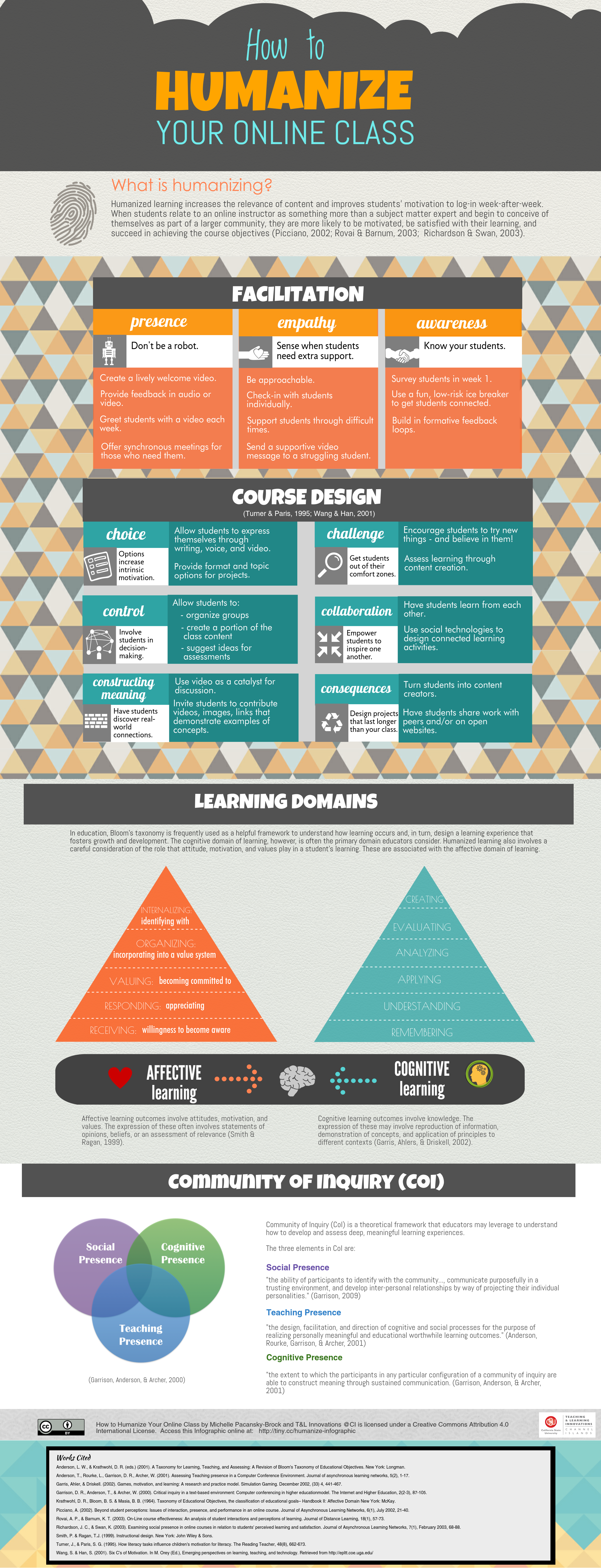
Michelle Pacansky-Brock, a noted leader in higher education with expertise in online teaching, produced the following "How to Humanize Your Online Class" infographic that offers additional information on humanizing online teaching through presence, empathy, and awareness, which were also described in detail in her article in the Research Support section below.
Creating a Supportive Environment When Teaching in Times of Crisis
When we consider all the various ways instructors can impact the learning environment, we also need to take into consideration how times of crisis or stress impact our teaching and learning environment.
Whether local, national, or international in scope, times of crisis can have a significant impact on the learning experience. The students need not be directly related or personally involved to experience anxiety or trauma. The resulting anxieties students—and teachers—bring into the classroom in response to a crisis can affect student learning.
Here are some ways you can support students (i.e., show empathy through teaching presence) in times of crises:
- Acknowledge the crisis. There are many ways to do this, from activities that only take a moment, to restructuring an entire course. You can also consider being lenient with due dates, reducing workload, or providing special synchronous sessions to give students a place to talk (be sure to talk about your academic leader about these strategies).
- Communicate with students. Remind students that you are still there for them and that if they need help to reach out to you. Invite them to help you adjust the schedule to deal with the new situation. Humanize yourself, and make it casual and lighthearted while using hopeful and optimistic language.
- Convey that it is normal to have intense emotions and difficulty concentrating. Let students know that most students (and, if you feel comfortable sharing, most instructors) feel anxious, frustrated, and uncertain in these kinds of circumstances.
- Let assessment be your guide for adaptation. Once you have graded assignments for the week, take the time to reflect on where students are excelling and struggling. Use that information to adapt your approach or determine if they need additional resources or support.
- Remain consistently engaged. Students feel more connected when they "see" their instructor consistently showing up in the class. That looks a bit different in the online environment but can include regularly posting in the discussion board, providing timely feedback, adding announcements with additional help or resources, and sending reminder communications.
Cultural Relevance and Responsiveness
As an institution focused on access, we invite you to spend time reflecting on how your personal and professional experiences and origins shape the way you teach and work with your students.
We value what you bring to our students, and also want to lend to you our experiences in creating a teaching culture that supports diversity, equity, and belonging. To this end, we believe in the body of literature supporting the use of Culturally Responsive Pedagogy (CRP), and the work of Gloria Ladsen-Billings, among others.
CRP centers around the notion that we can, and should include our student's cultural references in all aspects of our teaching—from the design of a course, to our instruction, and to the language we use with our students.
For more information, review Gay's (2000) Descriptive Characteristics of Culturally Responsive Pedagogy.
Gay, G. (2000). Culturally responsive teaching: theory, research, and practice. Teachers College Press.
Suggestions for Incorporating CRP into Your Everyday Practice
- Names. Names are important and so are the way they are spelled, used, and pronounced. Always use a student's name in all your interactions and pay attention to their pronunciation and to any nicknames they use that you could honor. While asking students can be a surefire way of learning the correct pronunciation, you can also use Google Translate by copying and pasting the name in the box, selecting the language, and listening to the pronunciation.
- Make the connection. Check in with your students and offer a phone call, synchronous meeting (e.g., via Zoom), and/or support when a student seems to fall behind. Individually reach out to your students—you will be amazed at their response!
- Contextualize learning. Unfortunately, many traditional learning materials are framed for a majority audience and may not reflect the diversity of our student body. Take the time to relate course materials to your students' diverse lives, backgrounds, and cultures (and/or make room for your students to do so) and do find materials and resources that are more reflective of diverse identities. You could even ask students to find resources and materials that reflect their lives for sharing with peers and inclusion in the course.
- Progressive stacks. If you summarize the discussion or an activity for the week in an announcement, take the time to highlight the contribution of students who may belong to a marginalized group or that seem to be more hesitant to bring their full selves to the class. We want you to recognize everyone, and this type of "stacking" is a subtle, yet high-impact gesture to those students who have been traditionally overlooked.
- Multimodal learning. Consider all the different ways a student can demonstrate mastery and find ways to accept these differences in your assessment strategy. It may mean that you modify an assignment description to also include alternative forms of submission such as a storytelling video, a podcast, an infographic, or other media besides a standard written document. The way you learn and process information may be very different than your students!
- High expectations with compassion. We want you to promote a healthy sense of accountability with your student by holding them to high standards, and with empathy and compassion. When providing feedback, pay particular attention to providing a clear path for validation, and also improvement.
Responding to Students' Lives Outside the Classroom
In addition to the in-class approaches we can implement to help students feel more connected, we also need to validate that our students have complex identities. To us, they are "students" but they often espouse many other roles in their personal and professional lives.
All learners have many competing priorities, and it's important for instructors to respond with compassion and support. As you saw in the Faculty Spotlight above, we should consider how "Maslow before Bloom" plays a role. That means that students’ needs around safety, shelter, food security, belonging, and esteem (see Maslow's Hierarchy of Needs) play a role in their readiness to grow and develop along a hierarchy of cognitive skills (see Bloom's Taxonomy).
In addition to the in-class approaches we can implement to help students feel more connected, we also need to validate that our students have complex identities. To us, they are "students" but they often espouse many other roles in their personal and professional lives.
All learners have many competing priorities, and it's important for instructors to respond with compassion and support. As you saw in the Faculty Spotlight #1 above, we should consider how "Maslow before Bloom" plays a role. That means that students’ needs around safety, shelter, food security, belonging, and esteem (see Maslow's Hierarchy of Needs) play a role in their readiness to grow and develop along a hierarchy of cognitive skills (see Bloom's Taxonomy).
Practical Ways to Support Students' Lives and Identities
- Start by assuming the best of your students. Though we know NLU faculty are a caring and emphatic group of educators, it is an important reminder to avoid feeling like you need to create a "gotcha" mentality for student behavior or issues that come up. Most of the time, students need care to then take in the learning. When you re-frame your teaching through a belief of good intent, good things happen for students and your learning community.
- Take time to get to know your students. In Module 1, we recommended taking notes when students introduce themselves in the beginning of a course. Allowing for introductions emphasizes their importance and your interest in them as people. These notes will be helpful as you interact with the students throughout the term, and strive to help make the content in the course more meaningful for them.
- Ask students for feedback throughout the course. You could use a Classroom Assessment Technique (CATs) in D2L or Google Forms such as an Exit Ticket/Slip or Muddiest Point. Exit Tickets and Muddiest Points are tools that give instructors a way to quickly assess how well students understand the material they are learning in class and can be used also to "check in" with how students are feeling—not to mention a great way to assess the course experience so you have time to make modifications before the course ends. Exit Tickets can be created using the quizzes in D2L (and could be at the end of each module or at the midpoint) or they could be a Zoom Poll (or PollEverywhere) at the end of a synchronous session. Muddiest Points could work the same way, and can also be set-up as a Discussion Forum that is open the entire term.
- Hold Virtual Office Hours. Finally, you may consider offering office hours either in-person or online (via Zoom or Google Meet), that may be especially appealing to students who may be easily intimidated by faculty in general and may have a limited frame of reference regarding social protocol in formal "classroom" situations. Don't worry if students don't show up, just the knowledge that you are available synchronously changes the perception and feelings of security of your students!
Research Support for Creating Faculty Presence in an Online Environment
Chickering, A. W., & Gamson, Z. F. (1987).Seven principles for good practice in undergraduate education. American Association for Higher Education, Washington, D.C. (ERIC Document Reproduction Service No. ED4282491). https://files.eric.ed.gov/fulltext/ED282491.pdf
- The authors wrote this seminal article in 1987, and it was based on decades of research on undergraduate education supported by the Association for Higher Education, The Education Commission of States, and the Johnson Foundation. As you review each of the principles, think about how it could be applied to different modalities, including face-to-face, blended, online, and remote.
Hodges, C., Moore, S., Lockee, B., Lockee, T., & Bond, A. (2020, March 27). The difference between emergency remote teaching and online learning. EDUCAUSE Review. https://er.educause.edu/articles/2020/3/the-difference-between-emergency-remote-teaching-and-online-learning
- As you read, think about how your own experience with face-to-face, blended, online, and remote learning relate to the authors' descriptions of each modality. Which aspects of each modality do you think most contribute to increased student learning outcomes, particularly as you migrate from one modality to another?
Lieberman, M. (2018, January 31). Making an impact in online courses. Inside Higher Ed. https://www.insidehighered.com/digital-learning/article/2018/01/31/high-impact-practices-enliven-staid-online-course-format
- The author provides a succinct overview of "high-impact practices" that promote learning, engagement, and completion. Which have you experienced or used in your own courses? How might these practices look "different" across modalities?
Rhodes, C. M., & Schmidt, S. W. (2018, November). Culturally responsive teaching in the online classroom. eLearn Magazine. https://elearnmag.acm.org/archive.cfm?aid=3274756
- This article discusses how the Culturally Responsive Pedagogy (CRP) framework can be used to incorporate cultural identities of adult learners into the online classroom. As you read, consider how you may already incorporate elements of the motivational framework described by the authors.
Website: The Community of Inquiry (https://coi.athabascau.ca)
- This website, developed and maintained by Dr. Randy Garrison at the University of Calgary, provides information about the Community of Inquiry (CoI) framework. Be sure to click the "CoI Framework" tab to learn about the three dimensions of the framework and how the relationship among these dimensions relates to students' perceived learning, satisfaction with a course, satisfaction with the instructor, actual learning, and sense of belonging.
Engagement and Extension
Duke Learning Innovation. (2020). Engaging Video for Teaching Online. https://learninginnovation.duke.edu/faculty-opportunities/online-teaching-and-learning/video-examples
- You can easily record instructor videos using a quality Webcam and/or Smartphone. However, Duke Learning Innovation offers some alternatives that may inspire you to think creatively about video in your course.
Kilgore, W. (Ed.). (2016). Humanizing Online Teaching and Learning. CreateSpace Independent Publishing Platform. https://humanmooc.pressbooks.com
- Chapter 5 of this online book focuses on using video to humanize online instruction. Video can enhance the what (representation), how (action and expression) and why (engagement) of online learning. You can read more about how humanizing the integration of video requires the application of critical digital pedagogies in order to locate, integrate, create, annotate, collaborate, and curate video resources.
Faculty Spotlight #1
Bettyjo Bouchey, M.B.A., Ed.D. presents a webinar for the Online Learning Consortium on keeping students engaged in a transition to online learning. (Click image to view video.)

In this webinar, Bettyjo examines how to Be Human, Be Present, and Be Adaptable when we navigate teaching in times of stress and crisis. What information in the webinar do you think you could adapt to your teaching?
- Bettyjo Bouchey, M.B.A., Ed.D Dean, Online Education
Faculty Spotlight #2
Sample audio "Welcome Message" created by Rob Watson, M.B.A. (Click image to hear audio.)

Rob says that one of the reasons he uses audio and video is to create engagement and a connection with the students. The audio is designed to provide context on the content and assignments. He said students seem to really enjoy it and often comment that it helps them make sense of the course and assignments and feel like he genuinely cares about them and their involvement in the course. Can you hear examples of presence, empathy, and awareness in this instructor's welcome message?
- Rob Watson, M.B.A. Undergraduate College
Faculty Spotlight #3
Keisha Rembert, M.A. brings trauma into recent historical context, including COVID-19, and face us with the realities of current needs for our students and ourselves. (Click image to view video.)

As you watch this video, think about how you can address the social emotional needs of your students during a time of collective trauma through compassion, connection, and communication.
- Keisha Rembert, M.A. Undergraduate College
Faculty Spotlight #4
"NLU faculty are great in their ability and desire to ensure our teaching considers students' lives and identities outside of school. Recently, I saw students were tired and feared the breakout room activity [in Zoom] would be something for them to 'get done' as opposed to a path to learning that I had hoped for, so I divided them up into small groups and had them complete the activity together throughout the week. My advice is, when in doubt, close the PowerPoint, look at their faces, and empower them with some choice."
 Suzette Fromm Reed, Ph.D.
College of Psychology and Behavioral Sciences
Faculty Spotlight #5
"Developing learning communities means a lot to me as an educator and that means the classroom, whether online or face-to-face, must have the instructor's presence. After reading Linda Darling-Hammond's book, Preparing Teachers for a Changing World, I like to think of our university as classrooms in a changing world as we find ourselves online. I love her quote in the section on Developing Learning Communities, where she says: "Research also suggests that a strong link exists between social and academic performance and that being in a strong classroom community affects academic achievement" (p. 336). We are the element in the classroom that creates that community, which is so intricately linked to social and academic performance."
 Seema Imam, Ed.D.
National College of Education
