
Youth Restorative Workshops
Restorative Justice as Critical Pedagogy for Civic Engagement by Joe Rice
The workshops were divided into five/six sessions over the span of five months, each of which addressed a pressing social-political issue upon which participants decided. Note one workshop was repeated due to a number of participants graduating from their host program at BUILD, Inc., at the beginning of 2024. Below, we outline the curriculum, as well as the restorative critical pedagogy we employed. Each circle workshop followed a basic sequence of events to ensure clarity and consistency:
- Opening Ceremony: Reaffirming shared values and agreeing on ground rules.
- Check-in: Personal introductions and initial responses to prompts.
- Guiding Questions: Framing the dialogue through Socratic style reflection.
- Activity: Experiential learning and group collaboration.
- After Activity Review: Debrief on insights gained or emergent questions.
- Check-out: Final thoughts and takeaways.
- Closing Ceremony: Acknowledging completion and ongoing commitment to civic engagement through restorative justice.
This semi-structured format produced a “restorative civic” education model that balanced an emphasis on personal growth and the often difficult task of group discussion on pressing issues, specifically the challenges of reckoning with America’s unresolved history of racial injustice and inequality (Nelsen, 2023; Winn, 2023).
Joe Rice acted as the main facilitator of restorative justice workshops, while BUILD staff and NLU faculty joined him as co-facilitators. Additional guests included:
- Darryl Allen, Professor (workshop 6)
- Camille Williams - Chicago Votes (workshop 6)
- Parrish Brown, Good Lookin Out RJ Founder (workshop 6)
- Lisa Spencer, Psychiatry Center staff and NLU student (workshops 5 and 6)
- Terrance Little, NLU student and Dean of Students employee (workshop 5)
- Rachelle Zola, Special Education teacher and activist (workshop 5)
- Sam Schweder, ATTIC in Madison, WI (workshop 4)
Youth participants received Restorative Justice Certificates at the end of the program.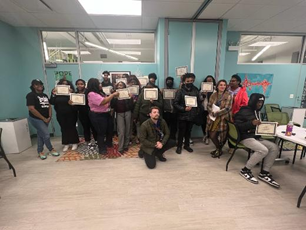
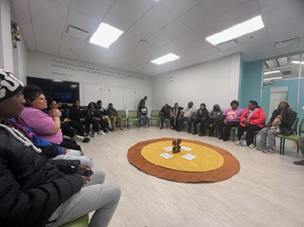
Images: March 2024 - Last Workshop organized at BUILD, INC
Workshop 1: The American Dream (October 2023)
The first workshop invited participants to question the concept of the American Dream, focusing on issues like social mobility, class conflict, and mass consumerism. The workshop opened with a quote from Teddy Roosevelt, who once said, “Nobody cares what you know until they know that you care,” setting the tone for a grounded, trauma-informed dialogue rather than a traditional lecture and, therefore, a rejection of the "banking model" of education, whereby the knowledge of American government is simply “deposited” into students who rely on rote memorization. Instead, the mission of our grant was introduced in rather straightforward terms: to hold space for participants' distinctive and diverse voices, to co-create the workshop experience, and to grow democracy organically. Firmly in the critical pedagogy lineage, the peace circle format lessened the social distance between teacher and student, between facilitator and participant, and in some instances, collapsed the distinction, as Paolo Freire put it in The Pedagogy of the Oppressed, "so that both are simultaneously teachers and students" (Freire, 2020).
A key activity in this workshop was a screening of the animated short film "Happiness" by Steve Cutts, which presents a sardonic rat race metaphor to critique American political culture as a consumerist hellscape. The high-octane animation provided an extraordinarily stimulating entry point for participants to discuss the various disconnects between societal promises of prosperity and the lived reality of unmet needs on the ground, many of which participants observed in their own community on the West side of Chicago - a historically disadvantaged region of the city. We then drew attention to two recent and local developments in city politics: the election last year of Mayor Brandon Johnson, a resident of the Austin neighborhood, and the Democratic National Convention, scheduled to take place at the United Center later in the year.
Workshops 2/3: Deliberative Dialogue (November 2023/January 2024)
The second/third workshop embodied the ideals of deliberative democracy by engaging youth in rapid-fire, improvised discussions on a series of controversial political issues. Topics such as military service requirements, criminal voting rights, police funding, the death penalty, gun rights, drug decriminalization, flag burning, border walls, and voter age were raised, essentially as a survey of ideas. The goal of this session was to spark civic dialogue and ensure that each participant had the opportunity to express their preconceived views while also actively listening to others. This session ended with participants narrowing their topics of civic interest to three: generational change, public corruption, and reproductive rights - and then voting on one, which would determine the focal point of the remaining workshops.
Workshop 4: Generational Change (February 2024)
The fourth workshop was centered on the theme of generational change, the topic that our youth participants overwhelmingly voted in favor of, as they felt it was particularly relevant to their own lives. The workshop began with an enigmatic quote from William Faulkner's Requiem for a Nun: "The past is never dead. It ain’t even past," which served as a prompt for discussions on the cyclical nature of history and the manifold ways in which past political events inevitably shape the future. According to John Dewey, a democratic education entails the “continuous reconstruction of experience”, which “may be treated as a process of accommodating the future to the past, or as a utilization of the past for a resource in a developing future” (Dewey, 2012).
Importantly, our participants engaged in intergenerational dialogue with local community stakeholders, including BUILD, Inc., staff, business leaders, religious clergy, activists, mental health professionals, graduate students, etc., all of whom shared their perspectives on how demographic and political shifts have shaped different generations—from the Lost Generation to Generation Alpha. Using guiding questions like, "What has been the defining moment of your generation?" and "What social-political events shaped your parents?", participants explored both historical and personal connections to the changing Zeitgeist (“spirit of the times”) in America.
Workshop 5: Intergenerational Trauma and Healing (March 2024)
The fifth workshop tackled the critical issue of intergenerational trauma and the ways in which cycles of harm can be broken through active acknowledgment and healing. The concept of "hurt people hurt people" was introduced using the case study of Ben Wilson, a Chicago basketball legend who was tragically murdered in the 1980s. The story helped frame the conversation around the intergenerational cycles of violence, trauma, and societal harm, as well as the journey of forgiveness that has ensued in the decades since the crime took place.
Participants engaged in a Jungian-inspired shadow work activity, where they were asked to identify a list of negative traits in someone they hate and then to reflect on how these traits also exist in themselves. The activity was designed to balance a sense of empathy with accountability, both of which are central tenets of restorative justice. This session encouraged participants to think more urgently about how healing within their own families can ultimately lead to larger-scale healing on a societal level.
Workshop 6: Social Media as a Platform for Civic Engagement (March 2024)
The final workshop explored the role of social media in civic engagement. Participants began by discussing what it means to be a good citizen and considered whether they typically utilize social media as a platform for connection or distraction. The conversation then shifted to youth voting and the common barriers that prevent many young people from participating in the democratic process, such as, “Voting doesn't make a difference,” “Politics is corrupt,” “Candidates don’t inspire enthusiasm,” “The powers that be suppress participation,” and, “Voters are confused on how to register, especially young voters.”
We explored the psychological architecture of storytelling in political campaigns (pulling levers of hope versus fear, threat versus opportunity) that makes viewers drawn into certain stories and compelled to, among other things, vote. The workshop then featured a creative activity where participants, working in small groups, devised TikTok-style political campaigns designed to encourage the youth voter bloc to turn out in the then-upcoming March 2024 Illinois primaries. Participants then performed their campaigns as short skits and then voted on their favorite social media stories. The workshop culminated with a case study of the Bring Chicago Home ballot measure - a proposed initiative aimed at addressing the root causes of homelessness. One of our community guests highlighted their personal struggle with homelessness, prompting the youth participants to consider what "home" means to them and how they can leverage their lived experience to contribute to the betterment of their communities.
By employing restorative justice practices to satisfy the basic psychological needs of participants, the civic engagement workshops linked the personal with the political and the political with the personal, and in doing so, empowered youth to view themselves as legitimate agents of change, capable of shared decision-making and collaborative problem-solving.
References:
- Brophy, N. S. (2023). Measuring Basic Psychological Need Fulfillment in Higher Education: An Investigation of Bifactor Exploratory Structural Equation Modeling In In-Person and Online Sections of an Introductory Communication Course. George Mason University.
- Bussu, A., Veloria, C.N., & Boyes-Watson, C. (2018). StudyCircle: Promoting a restorative student community. Pedagogy and the Human Sciences, 6, 1-20.
- Dewey, J. (2012). Democracy and education: An introduction to the philosophy of education. Courier Corporation.
- Freire, P. (2020). Pedagogy of the oppressed. In Toward a sociology of education (pp. 374-386). Routledge.
- Hollweck, T., Reimer, K., & Bouchard, K. (2019). A missing piece: Embedding restorative justice and relational pedagogy into the teacher education classroom. The New Educator, 15(3), 246–267. https://doi.org/10.1080/1547688X.2019.1626678
- Lyubansky, M., Mete, G., Ho, G., Shin, E., & Ambreen, Y. (2022). Developing a more restorative pedagogy: Aligning restorative justice teaching with restorative justice principles. In G. Valez, & T. Gavrielides, Restorative Justice: Promoting Peace and Wellbeing. Springer. https://doi.org/10.1007/978-3-031-13101-1_5
- Nelsen, M. D. (2023). The color of civics: Civic education for a multiracial democracy. Oxford University Press.
- Ryan, R. M., & Deci, E. L. (2017). Self-determination theory: Basic psychological needs in motivation, development, and wellness. New York: Guilford Publishing.
- Winn, M. T. (2023). Restorative justice, civic education, and transformative possibilities. The ANNALS of the American Academy of Political and Social Science, 705(1), 156-171.
- Vansteenkiste, M., Ryan, R. M., & Soenens, B. (2020). Basic psychological need theory: Advancements, critical themes, and future directions. Motivation and emotion, 44(1), 1-31.
- Zehr, H. (2015). The little book of restorative justice: Revised and updated. Simon and Schuster.
