
Communicating with Students and Grading in D2L
Effective Communication and Building Rapport with Students
Background
Many studies show that students will be more open to learning, work harder, care more, and be more engaged if they have a good relationship with their instructor (Sidelinger, 2010). Communication is often the first key to establishing good student rapport. Student success hinges on students developing not just academic skills, but more importantly, non-cognitive skills. These skills include grit, time management,self-efficacy, communication, and the ability to self-advocate. Since most high school students are not very proficient in these skills, it falls to college instructors to help students to develop a growth mindset and improve in these areas. This works best if the rapport between instructor and student is strong, if students regard the instructor as a mentor, if students respect the instructor and feel they can “talk” to them (Nathan & Barrett, 2014).
Communication Tools
Most often, instructors will communicate with students using the Classlist in D2L. This sends a message directly to their student email. However, you could also consider communicating via D2L Announcements, which can be scheduled to appear exactly when students need them. After class, consider utilizing a wrap-up announcement.
Grading Student Work
Grading is a Form of Communication
Keeping with the idea of communicating with students, one of the most important pieces of communication between faculty and student is feedback on graded or non-graded work. This feedback helps students understand their strengths and where they still have room for growth. That being said, when grading assignments, it is important to use a rubric so students understand what is expected of them. Since not all work is submitted to D2L, you will ocassionally need to enter grades directly into the gradebook.
As a way of assessing originality of assignments and reducingpPlagiarism, it is recommended that you Enable Turn-it-in. Be sure to explore each scenario with the student to determine if they are plagiarizing or just struggling to cite their sources.
Instructor-Student Rapport Research
Dobransky, N., & Frymier, A. (2004). Developing Teacher-Student Relationships through out of Class Communication. Communication Quarterly, 52, 211-223.
Frisby, B. N., & Martin, M. (2010). Instructor-Student and Student-Student Rapport in the Classroom. Communication Education, 59, 146-164.
Nathan G. W. & Barrett, L. O. (2014). Student views of instructor-student rapport in the college classroom. Journal of the Scholarship of Teaching and Learning, 14(2), 15 - 28.
Sidelinger, R. (2010). College Student Involvement: An Examination of Student Characteristics and Perceived Instructor Communication Behaviors in the Classroom. Communication Studies,61, 87-103.
Links to Online Articles:
http://www.socialpsychology.org/rapport.htm
http://www.facultyfocus.com/articles/teaching-and-learning/building-rapport-with-your-students/
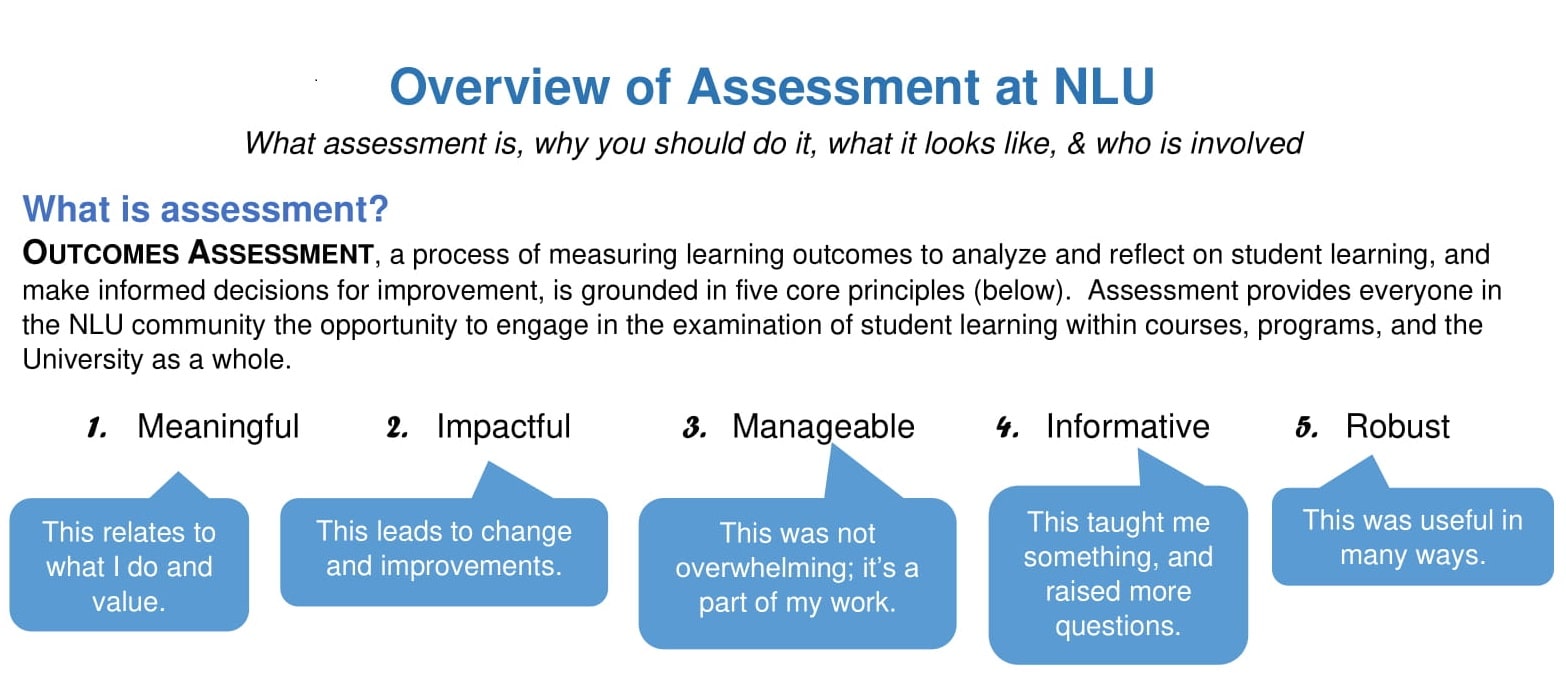

For additional information beyond the categories below, be sure to visit Assessment at National Louis University.

For additional information beyond the categories below, be sure to visitAssessment at National Louis University.

For additional information beyond the categories below, be sure to visit Assessment at National Louis University.
