
Progress Report Automation
New Automation in Progress Reports
We are introducing a new level of automation within the Progress Report page. Moving forward, when you open a Progress Report, the system will automatically suggest students who may need support, along with a recommended case subject and description.
These recommendations are based on multiple data points, such as D2L logins, attendance activity, and submitted assignments, and how those indicators compare to class averages. The goal is to help identify students who may be struggling or disengaged earlier in the term.
If a recommendation does not apply or you have already addressed the issue with a student, you may reject any or all of the system’s suggestions and complete the report as usual. If you accept the recommendations, the fields will auto-populate, and you may submit the Progress Report or add additional cases as needed.
Please note that this initial release focuses only on identifying students who may need support. Positive (“high-five”) cases will be added in a future update.
New Retain Reports: Attendance and Engagement
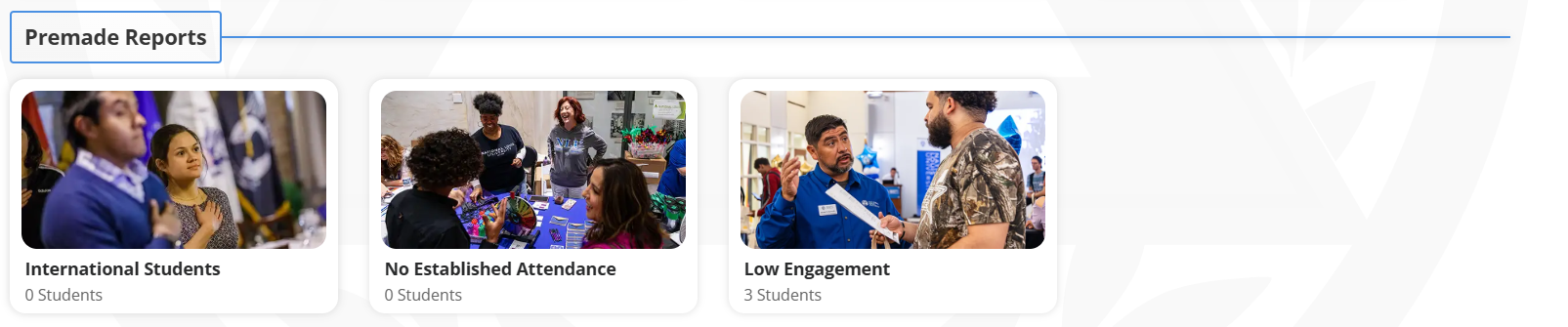
To support this automation, two new reports are now available on the Retain homepage:
- No Established Attendance
- Low Engagement
These reports can be accessed at any time and show which students were flagged and the reasons they were identified. Additional detail can be viewed by opening the student record and selecting your course in the Academics tab.

Updated Progress Report Schedule
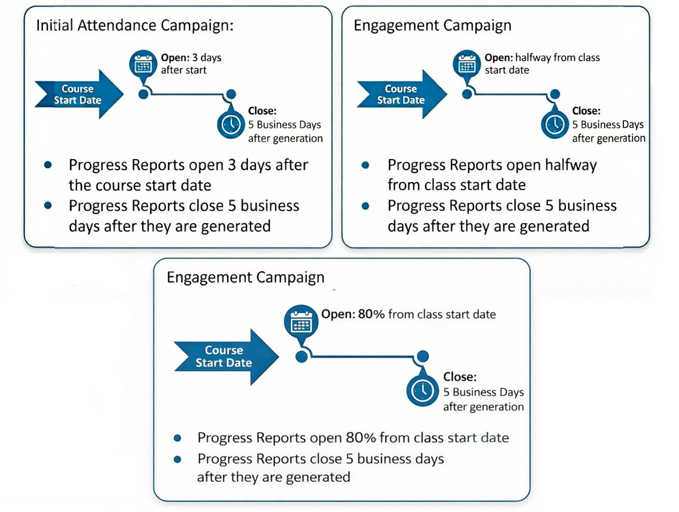
We are also making changes to the Progress Report schedule that affect both the Initial Attendance Report and the Engagement (Midterm) Report:
- Initial Attendance Report
- Generated on the third day of class
- Due five business days after generation
- Engagement (Midterm) Report
- Generated on the Monday of the week marking the course midpoint
- Due five business days after generation
- End Of Term Report (Excludes 4 & 5 Week Classes)
- Generated on the Monday of the week when the course reaches 80% completion
- Due five business days after generation
Please use the link below to view the Full Schedule for the upcoming Progress Report:
Progress Report Schedule Fall 2026
Going forward, if Progress Reports are not completed by the due date, the system will automatically submit the report using the system’s recommendations on the final day it is due. Therefore, it is important that faculty review and adjust any recommendations if they do not wish for cases to be raised for specific students.
Why Timely Attendance Reporting Matters
Timely and accurate attendance reporting is critical and is directly tied to Department of Education (ED) Title IV requirements. Institutions are required to establish and document student attendance and participation to ensure the appropriate administration of federal financial aid.
Accurate and timely reporting of students who establish (or do not establish) attendance allows the University to:
- Properly package and disburse federal financial aid
- Minimize the risk of students receiving aid for which they are not eligible
- Reduce the likelihood that students are later left with an unexpected financial balance owed to the institution
- Maintain compliance with federal regulations and audit requirements
In addition, timely attendance reporting ensures the University maintains an accurate enrollment count, which is essential for institutional reporting, compliance metrics, and strategic planning.
Attendance Policies and Faculty Guidance
Faculty play a critical role in establishing and reporting student attendance in accordance with federal regulations and University policy. The following Academic Catalog policies provide guidance on how attendance and participation should be determined and reported:
- Policy on Course Non-Attendance: This policy clarifies when a student has not established attendance and outlines when faculty action is required to ensure accurate reporting and timely student support.
https://nl.smartcatalogiq.com/en/current/undergraduate-and-graduate-catalog/financial-aid/financial-aid-policies/policy-on-course-non-attendance - Policy on Online Attendance and Participation: This policy defines what constitutes meaningful academic engagement in courses and helps faculty consistently document student participation.
https://nl.smartcatalogiq.com/en/current/undergraduate-and-graduate-catalog/financial-aid/financial-aid-policies/policy-on-online-attendance-and-participation
Importance of Engagement Reports and Campaigns
Engagement Reports and campaigns are a key tool for supporting student success. They allow faculty to document student progress and identify students who may be at risk in their courses.
Timely and accurate engagement reporting enables the University to:
- Identify students who may need additional academic or personal support
- Provide targeted, timely outreach and intervention
- Coordinate support across advising, student success, and academic teams
- Improve student persistence and overall outcomes
Early engagement reporting is one of the most effective ways we can proactively support students and intervene before challenges escalate.
Training and Support
To support this transition and answer questions, LITS will offer drop-in sessions prior to the start of the term to walk through the updated workflow and automation features. LITS will also record and publish video tutorials, which will be available in the Retain section of the NLU portal. Thank you for your continued partnership and for your commitment to supporting our students.
